



Victron Electrical Architecture: How Patrol Vans Designs Off-Grid Power Systems
Most buyers who shop a Sprinter conversion start by asking about square footage, beds, and seats. The electrical system tends to come up later, usually in the form of a single question: “How long can I be off the grid?” That question hides a much more important one — what’s actually under the cabinet, how the pieces talk to each other, and whether the system will still feel reliable five winters from now. The Sprinter van Victron electrical system isn’t a parts list. It’s an architecture, and we build it that way on purpose.
This guide walks through how Patrol Vans approaches off-grid electrical architecture across every build we ship. It covers the components, the design rules that determine how those components are sized, and what an owner can realistically do with the result.
What “electrical architecture” actually means in a Sprinter conversion
An electrical architecture is the design relationship between power generation, power storage, power distribution, and power management. Every Patrol Vans build carries four sub-systems that have to work together:
The house battery bank stores energy in lithium chemistry (LiFePO4) cells. The inverter / charger converts stored DC into 120V AC for outlets and appliances, and converts shore power into DC to recharge the bank. Solar input harvests energy through roof panels via maximum power point tracking (MPPT) controllers. Alternator charging uses the Sprinter’s engine to top up the bank via DC-DC converters when you drive.
The architecture decision is how those four sub-systems coordinate. On a budget build, they don’t — each piece operates independently, with no central monitoring and frequent corner-cases (e.g., shore power and solar both trying to charge a full bank simultaneously). On a premium build, they share state through a central controller and behave predictably under every condition.
Why Patrol Vans standardizes on Victron Energy
Victron is the brand we install in every Patrol Vans build. The reasons are practical rather than promotional.
Component quality and longevity
Victron’s marine-grade pedigree means individual components carry industrial design margins. We see fewer field failures on Victron inverters, MPPT controllers, and shunts than on any other brand we’ve evaluated. Owners who keep their builds for ten years aren’t replacing the electrical components — they’re replacing the lithium cells once, around year eight, and continuing to run the same hardware.
Inter-component communication (Cerbo GX)
Victron’s Cerbo GX is the system controller that turns a collection of components into a coordinated architecture. The Cerbo reads state from every connected device — the inverter knows the battery’s state of charge, the solar controller knows whether shore power is providing the load, the alternator charger knows whether the bank is full. The result is a system that behaves like an appliance rather than a science project.
Remote monitoring (Victron Connect, VRM)
Every Patrol Vans build with the Cerbo GX gets remote monitoring through Victron’s VRM portal. Owners check state of charge, solar harvest, and inverter load from their phone whether they’re parked at home or at a trailhead. We also use VRM during commissioning — every system gets validated against expected harvest curves before the keys change hands.
The Victron components in a Patrol Vans build
Each Patrol Vans build carries a defined set of Victron components, sized to the model and the owner’s intended use. The components are consistent; the capacities scale.
MultiPlus inverter / charger
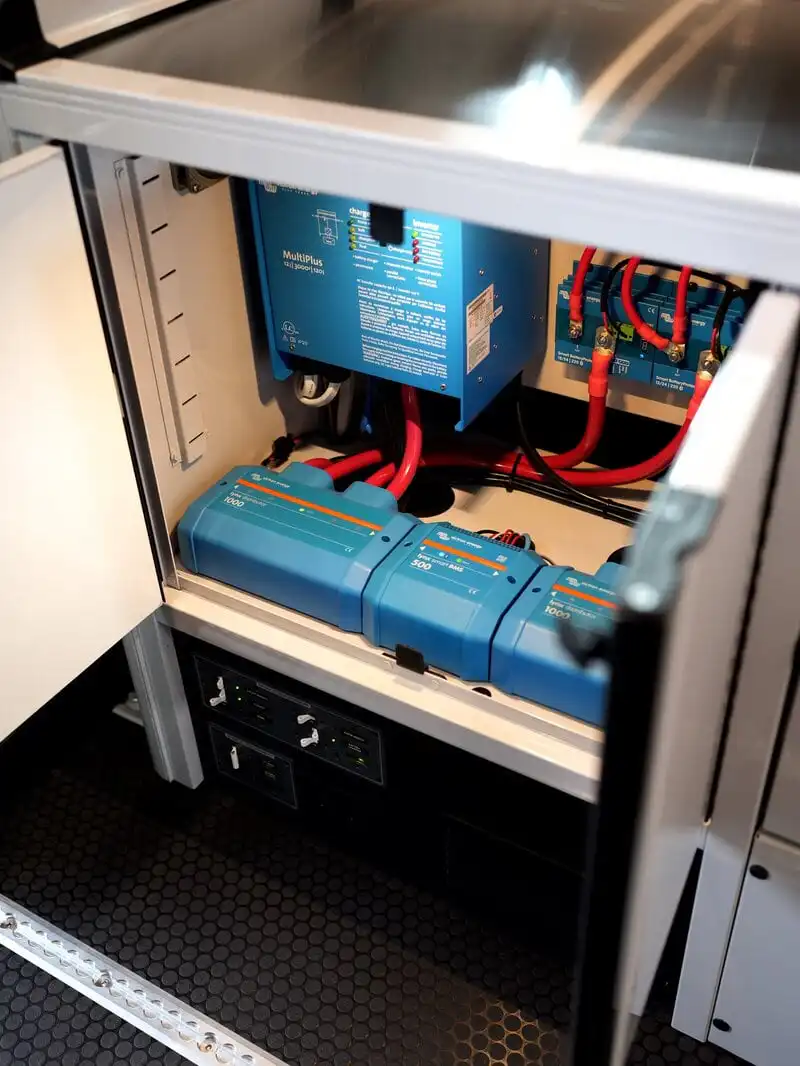
The MultiPlus is a combined inverter and shore-power charger in a single chassis. AlphaVan builds typically run a MultiPlus 12/2000 (2,000W continuous AC output); EchoVan and OmegaVan can step up to MultiPlus 12/3000 or MultiPlus-II Inverter / Charger 12/3000-120-50 depending on appliance load.
SmartSolar MPPT controllers
SmartSolar MPPT controllers harvest from the roof panels and feed the lithium bank. We size the MPPT to the panel input on each build — typically 100/30 for AlphaVan, 100/50 for EchoVan, and 150/85 for OmegaVan utility builds with larger solar arrays.
SmartShunt and battery monitoring
The SmartShunt sits between the battery negative terminal and the rest of the system, measuring every amp in and out. It’s the source of truth for state of charge — the number the owner trusts. Bluetooth pairing lets owners read SoC on their phone without opening any cabinet.
Orion-Tr DC-DC alternator chargers
Orion-Tr 12/12-30A DC-DC chargers handle alternator charging during driving. They isolate the lithium bank from the Sprinter’s electrical system (lithium and alternators don’t talk well natively), and they let the bank harvest while you drive between camps.
Cerbo GX system controller
The Cerbo GX ties everything together. It’s the brain. It also provides the touchscreen interface (GX Touch 50) we mount in the galley on most builds, so owners get a system overview without reaching for their phone.
How we size the system to the build
Standardizing on Victron doesn’t mean every build gets the same capacity. Sizing is the part of electrical architecture that varies most by use case.
AlphaVan — light off-grid, weekend capable
AlphaVan is our adventure-ready entry build. The standard electrical specification is a 200Ah LiFePO4 bank, 400W of roof solar, a MultiPlus 12/2000, and a single Orion-Tr alternator charger. That’s enough for a long weekend in the woods running lights, fans, a 12V fridge, device charging, and short bursts of AC for a coffee maker or small induction cooktop. Buyers who plan to spend more than 2-3 nights between hookups should look at EchoVan.
EchoVan — week-long boondocking
EchoVan steps up to a 400Ah LiFePO4 bank, 600W of solar, MultiPlus 12/3000, and dual Orion-Tr chargers for faster alternator harvest. The doubled bank capacity is what unlocks the “week without recharging” capability — and it’s the system that the EchoVan boondocking electrical guide (A3 in this batch) covers in detail.
OmegaVan — utility-heavy, tool support
OmegaVan builds support work tools, communications gear, and onboard equipment. The standard electrical specification scales to a 600Ah LiFePO4 bank, 800W+ of solar, MultiPlus-II 12/3000-120-50, and a larger MPPT (150/85). The MultiPlus-II’s higher continuous AC rating and 50A pass-through let OmegaVan owners run larger tools (table saws, welders on the smaller end) without tripping breakers.
What this system lets owners actually do
The honest answer is “depends on the use case,” but with a coordinated Victron architecture, the realistic capability looks like this:
An AlphaVan owner can run a typical campsite load (lights, fan, fridge, devices, occasional small AC appliance) for 2-3 nights between solar harvests. With a sunny afternoon of solar input, the bank fully recovers without needing shore power or driving.
An EchoVan owner can do the same load for 5-7 nights, or push higher loads (induction cooking, longer device sessions, heated mattress pad in shoulder season) for 3-4 nights. Boondocking math gets covered in detail in the EchoVan boondocking electrical guide.
An OmegaVan owner running utility loads (work tools, comms equipment, longer-running induction or heat-pump appliances) gets enough headroom to operate as a true off-grid work platform — the kind of capability that field photographers, outdoor industry professionals, and adventure-driven contractors need.
What this system is not
It’s not a substitute for a generator on long, sunless winter trips. It’s not a workshop-grade welding rig (the largest welders draw more than even our OmegaVan can deliver). It’s not designed to run residential HVAC at scale — Patrol Vans builds heat-pump-based climate control with separate sizing math.
The system also isn’t a permanent install of “infinite power.” Lithium cells age. Solar harvest depends on latitude and season. Real-world use teaches every owner where their capability ceiling sits. We design for realistic use, not advertised peak numbers.
Frequently asked questions
What’s the difference between a 12V and 48V Victron system? Most Patrol Vans builds run at 12V because the Sprinter and our 12V appliance set are designed for that voltage. 48V Victron systems exist for bigger residential off-grid installs but introduce complexity and component cost that doesn’t pay off in a van-scale architecture.
Can I add to a Patrol Vans Victron system after delivery? Yes. The architecture is designed for expansion — adding panels, increasing bank capacity, or swapping the inverter for a higher rating is straightforward because every component coordinates through the Cerbo GX. We help owners scope upgrades.
Why LiFePO4 instead of lead-acid? LiFePO4 cells deliver roughly 80% usable depth-of-discharge per cycle (vs ~50% for lead-acid), last 4-5x more cycles, weigh roughly half, and recover from full discharge without damage. The cost premium is real but the lifetime cost per usable amp-hour is lower.
Do I need to plug in shore power regularly to keep the system healthy? No. LiFePO4 doesn’t suffer from the sulfation that plagued lead-acid. As long as the bank cycles regularly (which solar + driving do automatically), it stays healthy.
How do I monitor the system from off the van? The Cerbo GX uploads to Victron’s VRM cloud portal. From your phone or laptop anywhere with internet, you see live SoC, solar harvest, and inverter status. Useful for storage periods between trips.
What if a component fails on the road? Victron components are field-serviceable and replacement parts ship overnight from US distributors. The architecture’s modularity means a single component failure doesn’t cascade — the SmartShunt failing still leaves you with a functional inverter, MPPT, and alternator charger. We also include diagnostic walkthrough documentation with every build.
Where to go from here
If you want the per-model spec deep-dive, the next two articles in this cluster cover the AlphaVan electrical specs (battery sizing, solar specs, Victron component list) and the EchoVan boondocking electrical architecture (the math behind a week without recharging). You can also explore the AlphaVan, EchoVan, and OmegaVan build options, or talk with the Patrol Vans team about the right electrical architecture for your travel pattern.
External references: Victron Energy, Battle Born Batteries.