

Building a Modular Sprinter Interior: How Smartfloor, L-Track, and Adventure Wagon Panels Work Together
Buyers shopping a custom Sprinter conversion encounter the word “modular” constantly. It means different things in different shops. In a Patrol Vans build, “modular Sprinter interior” describes a specific integration of three systems that each handle a different part of the modularity problem: Smartfloor at the floor level, L-Track on walls and ceilings, and Adventure Wagon panels and A-Frame as the structural skeleton. Each system on its own is useful. The three together are what make a Patrol Vans interior actually reconfigurable across the life of the van.
This article walks through how we install and integrate the three systems, what each one does, and the practical capability the integration delivers. For the broader Smartfloor explainer, see our Smartfloor article from May. For the Smartfloor vs L-Track comparison specifically, see the Smartfloor + L-Track comparison piece.
What “modular interior” actually means in a Sprinter conversion
A modular interior is one whose layout can change without rebuilding the van. The buyer who specs a 4-passenger configuration for family weekends should be able to convert to a 2-passenger plus cargo configuration for a solo gear-hauling trip without calling a shop or running a fabrication job. The buyer who configures for adventure travel this year should be able to reconfigure for remote-work next year — same van, different layout.
Modularity isn’t just about removable seats. It includes mounting flexibility for gear, sleeping configurations that adapt to the trip length, partition placement that can change as needs change, and the ability to add accessories without drilling new holes through a finished panel every time.
Three systems, each handling a different surface of the van, deliver that flexibility. We install all three in every Patrol Vans build.
The three modularity systems we install
Smartfloor — the floor-level grid
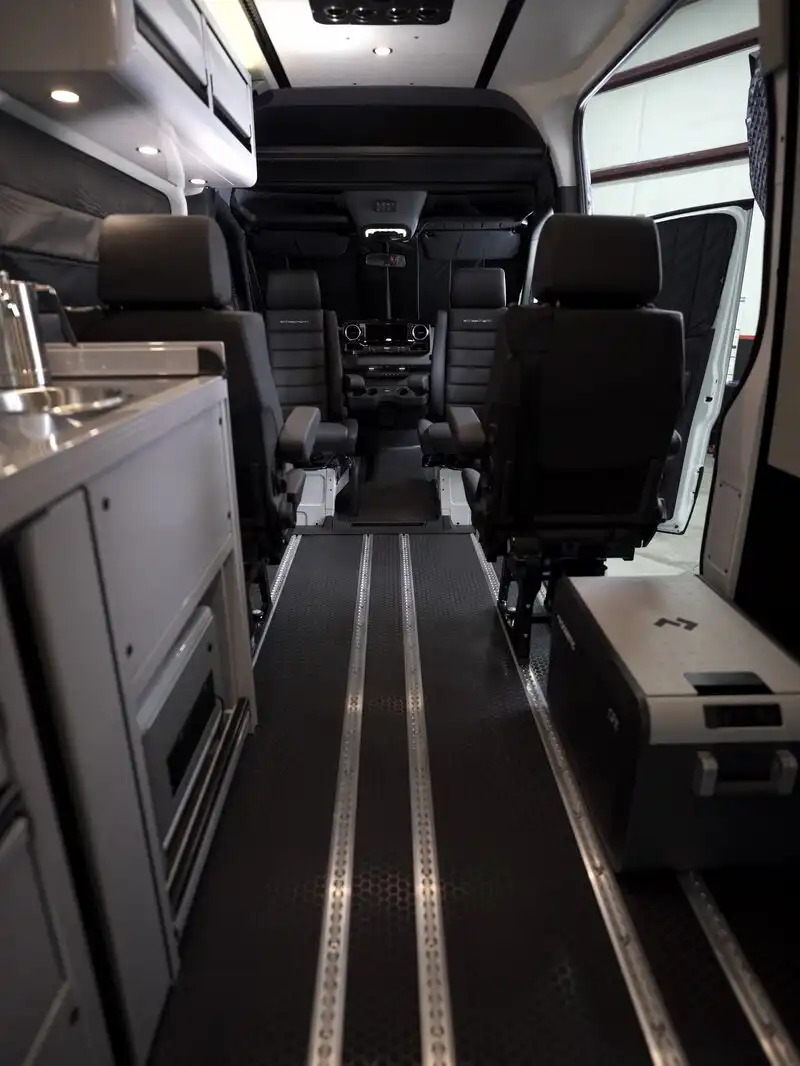
Smartfloor is a modular flooring system from RRE-Global. It replaces the typical fixed plywood-and-vinyl Sprinter floor with a grid of anchor points sized to the FMVSS-certified seat bases (CMC and other certified mounts). Owners can move seats, mount cargo restraints, or convert a section of floor to sleep platform — using only an Allen key, no shop visit required.
From a build-architecture standpoint, Smartfloor is the foundation. Every other modular system sits on top of it. The Smartfloor decision happens before any cabinet or panel goes in.
L-Track — wall and ceiling mounting rails
L-Track is the aviation-cargo-derived mounting rail standard that’s become the de-facto wall-and-ceiling mounting system for modular vans. Patrol Vans installs L-Track on interior side walls, the rear door interior, and along the ceiling rail line. Each rail accepts the same family of fittings: cargo tie-down rings, accessory mounts, gear hangers, modular shelving brackets, fold-out platforms.
The benefit is consistent: any modular accessory rated for L-Track can mount anywhere we’ve installed rail, and the same accessory can move to a different rail location later. The most common owner upgrade post-delivery is adding L-Track-compatible storage solutions — those installations don’t require touching the wall finish, just clicking into the existing rail.
Adventure Wagon panels and A-Frame — the structural skeleton
Adventure Wagon makes modular interior panel systems and structural components for Sprinter conversions. The A-Frame is a structural sleep / partition framework that supports configurable bed platforms and load-bearing accessories. The modular ceiling panels, side panels, and door panels are dimensioned to Sprinter wheelbase configurations and finished to premium-build standards.
Patrol Vans installs Adventure Wagon’s A-Frame and modular panel system as the interior skeleton in most builds. We’re a professional installer of their components rather than a DIY kit assembler — the install integrates with our cabinet work, L-Track mounting, and Smartfloor floor system as a coordinated whole.
How the three systems work together
Integration isn’t automatic. Each of the three systems has its own design constraints, and getting them to coordinate in a finished interior takes deliberate sequencing during the build. Here’s how we do it:
Step 1 — Floor first (Smartfloor as the foundation)
Smartfloor goes in before any wall finish, before any cabinet, before any L-Track install. The reason is dimensional: the Smartfloor grid sets the anchor positions for every seat base, every cargo restraint, every floor-mounted accessory. Everything above the floor is dimensioned to those anchor positions. Trying to retrofit Smartfloor under a finished cabinet would mean tearing the cabinet out.
Step 2 — Wall and ceiling L-Track placement
L-Track installs against the metal of the Sprinter chassis behind whatever finish material we plan to use (typically wall vinyl, headliner panels, or finished plywood). The rail position is measured from the Smartfloor grid so that L-Track mounting positions align with floor anchor positions — meaning an upright partition between two seat bases on the floor lines up cleanly with an L-Track tie-off on the wall above.
Step 3 — Adventure Wagon A-Frame and panel integration
The Adventure Wagon A-Frame mounts to wall structural points (not to the chassis directly — the A-Frame is designed to anchor to the conversion’s own framework). The frame’s bed-platform supports and accessory rails are dimensioned to coordinate with the L-Track positions installed in Step 2. The Adventure Wagon ceiling panels and side panels are sized to the wheelbase variant and trimmed during install to match the door and window cutouts of the specific Sprinter chassis.
This is the step where the value of single-shop execution becomes obvious. Coordinating Smartfloor anchor positions, L-Track placement, and Adventure Wagon component fit in a sequence requires every step to happen against the same set of dimensions. We measure once at the chassis level and design every subsequent step to that measurement.
Step 4 — Modular load-out (sleep, seating, gear, work)
With the three foundational systems installed, the load-out happens. Seat bases drop into the Smartfloor grid. Storage and gear mounts click onto L-Track. Bed platforms set into the Adventure Wagon A-Frame. Each piece is independently removable, reconfigurable, and replaceable.
Why we integrate all three rather than picking one
Each of the three systems is useful on its own, but each has gaps that the other two fill.
Smartfloor alone gives floor-level modularity but no wall mounting strategy beyond drilling into finished walls. L-Track alone gives wall and ceiling modularity but doesn’t solve seat configuration. Adventure Wagon panels alone give structural integration but require their own mounting strategy for accessories.
The integration handles each gap: Smartfloor for the floor surface, L-Track for the walls and ceiling, Adventure Wagon for the structural skeleton. The buyer gets reconfigurability across every interior surface rather than just one.
The trade-off is build complexity. A budget conversion might use one of these systems and treat the others as “future upgrades.” A Patrol Vans build treats all three as standard equipment. The build cost reflects that, but the resulting modularity is real — owners actually use it over the life of the van.
What this enables (real-build use cases)
An EchoVan owner can run a 4-passenger configuration for a weekend road trip, convert to a 2-passenger + bike-rack-and-gear configuration for a mountain biking trip the next week, then convert again to a remote-work configuration (work surface, monitor, communications gear) for an extended trip the week after. Same van, three different layouts, with no shop visit required.
An OmegaVan utility-build owner can run a tool-and-equipment configuration for work trips and a sleep-platform configuration for overnight stays at job sites, switching between them as the work week dictates.
A family-build owner can run kid-seat configurations during school year travel and adult-trip configurations during summer cross-country trips. The same Patrol Vans build adapts as the family’s needs evolve.
These aren’t hypothetical scenarios — they’re patterns we see actively across Patrol Vans owner trips.
Maintenance, longevity, and reconfiguration
All three modularity systems are designed for repeated reconfiguration. Smartfloor anchor points are rated for FMVSS seat-base cycles in the thousands. L-Track is aviation-grade and rated similarly. Adventure Wagon panels are designed to mount and unmount as part of normal service.
Owners who reconfigure regularly (most of our adventure-class owners) don’t see meaningful wear on the modularity systems themselves. The wear that does happen is on the seats, mattresses, and gear that actually get used — all of which are themselves replaceable through the same modular interfaces.
Frequently asked questions
Can I add modular components after delivery? Yes. L-Track accepts any rated L-Track fitting. Smartfloor accepts any FMVSS-certified seat base on the standard footprint. Adventure Wagon accessories work with the installed A-Frame and panel system. We help owners scope post-delivery upgrades.
Do the three systems work with non-Sprinter chassis? Each system has Sprinter, Transit, and ProMaster-specific configurations. Patrol Vans builds on Sprinter exclusively, so we install the Sprinter-specific variants. The integration approach would translate to other platforms but the dimensional specifics differ.
Is the Adventure Wagon component part of the AlphaVan / EchoVan / OmegaVan standard build? The A-Frame and panel system is standard across all three models. Specific Adventure Wagon accessories (M.U.L.E., specific accessory hangers) vary by configuration.
What’s the difference between a DIY Adventure Wagon install and a Patrol Vans build with Adventure Wagon integrated? The DIY kit gives an owner-installer the components and instructions. A Patrol Vans build with Adventure Wagon integration delivers a finished interior where the Adventure Wagon system coordinates with our Smartfloor and L-Track installations as designed, with the cabinet work, electrical routing, and structural integration handled to premium-build standards.
Can I see real-build examples of the integration? Yes. The Basecamp configurator and the model pages — AlphaVan, EchoVan, OmegaVan — show finished examples. Owners are welcome to visit the Charleston shop and see in-progress builds.
Where to go from here
If the integrated modular interior pattern fits your use case, the model pages walk through what each Patrol Vans build delivers, and the Patrol Vans team can scope a build conversation. For more on the individual systems, see the Smartfloor explainer or the Smartfloor vs L-Track comparison.
External references: Adventure Wagon for A-Frame, L-Track, M.U.L.E., and modular panel product details; RRE-Global for Smartfloor.