




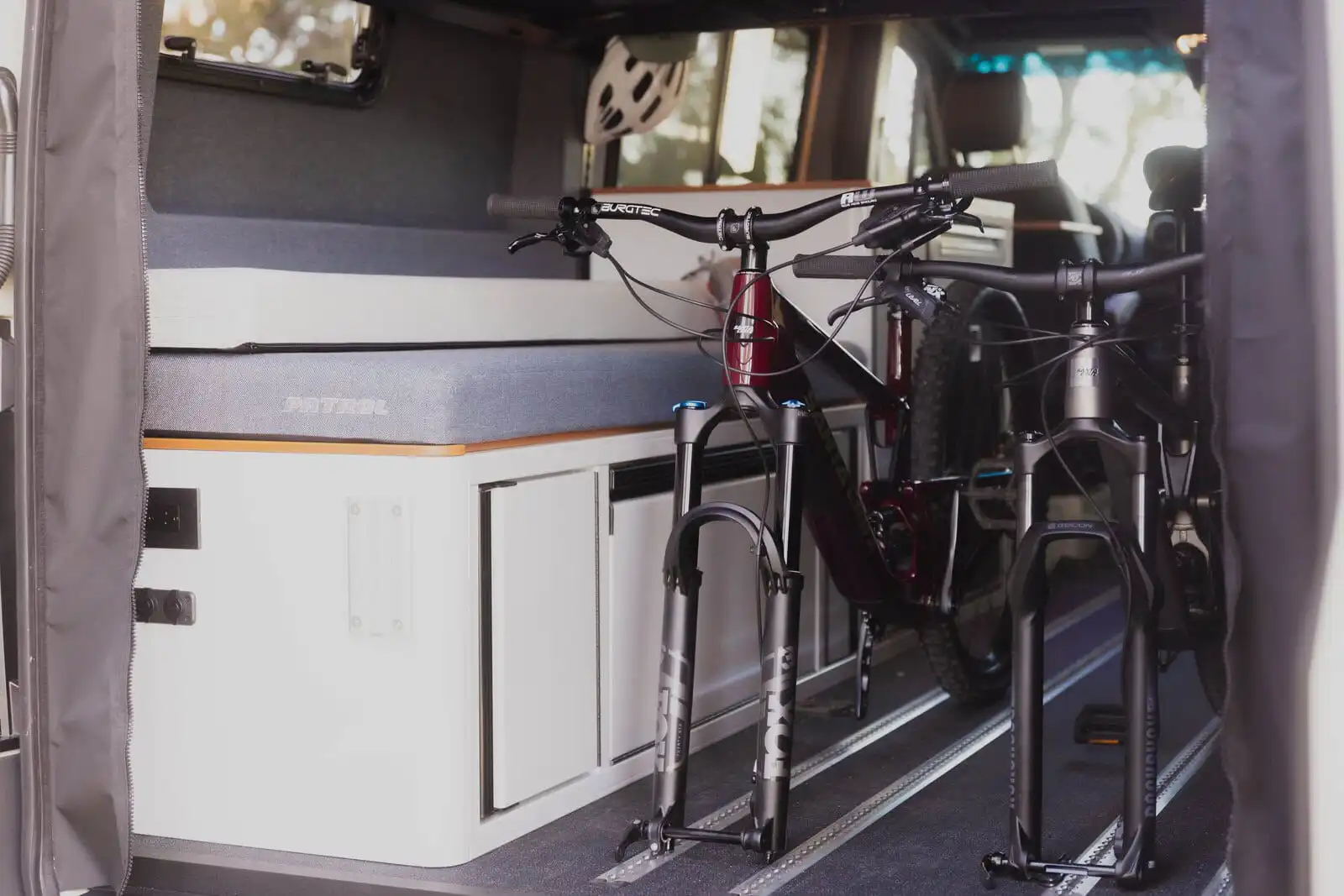
A Smartfloor system is a modular, FMVSS-compliant aluminum vehicle floor with a full grid of anchor points, so certified seats, benches, beds, and cargo mounts can be added, moved, or removed by hand with no drilling and no permanent brackets. Originally engineered by RRE-Global for European emergency-response vehicles, it is the modular flooring system that anchors every Patrol Vans build.
Smartfloor vs L-Track vs bolt-in flooring: a quick comparison
| Capability | Smartfloor | L-Track | Bolt-in floor |
|---|---|---|---|
| Reconfigure by hand, no tools | Yes, foot-pedal seat release | Partial, unlatch and rebolt hardware | No, permanent |
| Crash-rated passenger seating | Yes, FMVSS 207/210/225 certified bases | Limited, depends on hardware | Varies by build |
| Cargo and accessory flexibility | Full-floor anchor grid | Rail lines only | None |
| Install permanence | Modular and removable | Semi-permanent rails | Permanent |
| Relative weight | Moderate, structural panel | Light | Light to moderate |
If you’ve spent time researching premium Sprinter van conversions, you’ve probably seen the word Smartfloor referenced in build spec sheets, configurator menus, and walkthrough videos — usually without much explanation of what it actually is or why it matters. That’s frustrating when you’re trying to compare builders. The system itself is well-engineered, but the marketing around it tends to assume you already understand it.
This guide is the explanation that’s missing. We’ll cover what the Smartfloor system is, how it differs from L-Track and bolt-in flooring, what it lets you do that conventional van interiors can’t, and where it fits in a real Patrol Vans build.
What the Smartfloor system actually is
Smartfloor is a modular flooring system originally engineered by RRE-Global for European emergency response vehicles. It uses a structural floor panel drilled with a precise grid of mounting points, paired with a library of certified seat bases, cargo restraints, and accessory mounts that lock into that grid in seconds and unlock just as fast.
The simplest way to think about it: the floor is the chassis for your interior. Every seat, every storage module, every bed frame attaches to the same grid using the same anchor type. Nothing is permanently bolted to the van’s body. Nothing requires welding, re-upholstery, or a body shop to reconfigure.
For Patrol Vans builds, Smartfloor is the structural foundation under the AlphaVan, EchoVan, and OmegaVan model lines. It’s also the reason our customers can move a third-row bench out of the van in under five minutes when they need cargo room — and put it back in just as quickly when they’re hauling people again.
How Smartfloor differs from L-Track and bolt-in flooring
Three flooring approaches dominate premium Sprinter conversions today. Each makes a different tradeoff between flexibility, weight, and crash-rated certification.
Bolt-in floors
The default approach in most conversions: a plywood or composite subfloor laid over the factory metal, then a finished surface (vinyl, marine-grade laminate, sometimes hardwood). Furniture is bolted directly through the subfloor into the chassis. This is the cheapest, simplest path — and the hardest to change later. Reconfiguring the interior usually means cutting and patching the floor.
L-Track
L-Track is an aluminum extrusion that mounts to the floor in long parallel runs. Anchors and tie-downs slide along the track and lock at any point. It’s well-loved for cargo restraint and is the basis of many DIY conversion kits, including Adventure Wagon’s modular interior products. L-Track is excellent for what it does, but the surface area available for crash-rated seat mounting is limited to the tracks themselves, and there’s no certified bus-grade seat library designed specifically for it the way there is for Smartfloor.
Smartfloor
The full-floor grid approach gives you anchor points across the entire usable area of the van, not just along parallel rails. The grid is engineered around FMVSS 207/210/225 crash-rated seat bases — the same standard automakers use for factory-installed seating. That certification matters when you’re transporting people, especially kids, and matters even more when an insurance adjuster or a transit authority asks how your seating is mounted.
For a side-by-side comparison of removable seating specifically, see our breakdown of how Smartfloor and L-Track compare for removable seats.
What Smartfloor lets you do that other floors don’t
The capability that sells most buyers on Smartfloor isn’t visible in a photo. It shows up the first time you reconfigure the van.
Three-minute reconfiguration. A standard Patrol Vans Smartfloor seat base unlatches with a foot pedal. One person can lift the seat, walk it out the side door, and have the floor clear in under three minutes. The same operation on a bolted-in bench requires tools, two people, and usually a half-day in a body shop.
Crash-rated seating. Every seat that attaches to the grid is engineered and certified to FMVSS standards. You can move that seat to any anchor location in the van without re-certifying anything — the certification is for the seat-and-base assembly, not the position. For families and outfitters this is the unlock.
True modular layouts. A weekday work-utility van becomes a weekend four-passenger overland rig becomes a Monday-morning gear hauler. The same vehicle. The same factory drivetrain. The interior changes around you.
Future-proof customization. Buyers’ needs change — new kids, new gear, new use cases. A Smartfloor-equipped van adapts. A bolt-in floor commits you to whoever you were when you bought the build.
Where Smartfloor fits in a Patrol Vans build
Every Patrol Vans model — AlphaVan, EchoVan, and OmegaVan — is built on a Smartfloor foundation. The configuration of the seats, sleeping platforms, galley modules, and gear storage varies by model and customer specification, but the underlying grid is consistent.
Practically, that means a few things for buyers:
The system is designed for long ownership. Buyers who upgrade from AlphaVan to OmegaVan two years in can usually carry their Smartfloor-anchored modules over. The chassis changes; the interior philosophy does not.
It also means our internal build process is faster and more repeatable than a one-off bolted conversion. We’re not laying out a new floor for every customer. We’re configuring a known system to a specified use case, which reduces both build time and the long-term risk of squeaks, rattles, and structural failures that plague custom-built furniture.
What Smartfloor doesn’t do
The honest comparison goes both directions. Smartfloor is the right answer for most of our customers, but not everyone.
If you want a fixed, fully built-in residential interior — hardwood cabinetry permanently joined to the walls, a fixed kitchen with stone countertops, no expectation of ever reconfiguring — a traditional conversion gives you slightly more interior volume because there’s no certified base-and-anchor hardware taking up floor depth. The tradeoff is permanence. You’re buying that interior for the life of the van.
Smartfloor also costs more than a bolt-in floor up front. The certified hardware, the engineering, and the labor to install the grid properly aren’t free. Buyers who plan to use the van one way and never change it sometimes save money with a fixed build. Buyers whose use case is genuinely modular — which describes most adventure, family, and utility-hybrid use cases — pay the up-front premium back many times over.
Frequently asked questions
Is the Smartfloor system crash-rated for passengers?
Yes. The certified Smartfloor seat bases used in Patrol Vans builds meet FMVSS 207, 210, and 225 — the same federal motor vehicle safety standards that govern factory-installed automotive seating, including child-restraint anchor points. The certification covers the seat-and-base assembly at any approved anchor location on the grid.
How long does it actually take to move a Smartfloor seat?
Under three minutes per seat for a single person working without tools. We’ve watched customers clear an entire third row in under ten minutes when they need full cargo capacity for a gear run.
Can I add or move Smartfloor components after my van is built?
Yes. The whole point of the system is that the grid is permanent and the modules are portable. You can buy additional certified seats, sleeping platforms, or cargo modules from us at any point and add them to your existing Smartfloor without modifying the van.
Does Smartfloor add a lot of weight versus a standard floor?
Less than most buyers expect. The grid panel itself is engineered for high strength-to-weight, and you’re saving weight elsewhere by not building permanent furniture into the chassis. Net weight on a typical Patrol Vans build is comparable to a fully built-in conversion.
What van platforms support Smartfloor?
Patrol Vans installs Smartfloor in Mercedes Sprinter platforms — the chassis the rest of the build is engineered around. The Smartfloor system itself has been adapted for other commercial van platforms in European fleet applications, but the Patrol Vans configuration is Sprinter-specific.
Where to go from here
If you’re trying to decide between a fixed conversion and a Smartfloor-equipped Patrol Vans build, the deciding question is usually about how you actually use the van — not how you imagine using it. People who reconfigure their interior more than once a year almost always wish they’d bought modular. People who never reconfigure it sometimes wish they’d saved the up-front cost.
The fastest way to find out which side of that line you’re on is a real conversation about the use case. Talk with the Patrol Vans team about how you intend to use the van across a typical year, and we’ll tell you honestly whether Smartfloor earns its premium for your situation. If the model fit is already clear, explore the Patrol Vans build options to see how each model uses the system.
For technical background on the Smartfloor platform itself, RRE-Global maintains the engineering documentation at rre-global.com/smartfloor.