




Searching Sprinter van floor plans is usually the moment a build gets real. You stop imagining “a van” and start asking the concrete questions: where does the bed go, how much gear can I carry, can it seat passengers, does it work for two people or four? The truth most layout galleries skip is that there is no best Sprinter van floor plan — only the one that matches how you actually travel. This guide walks through the major layout patterns, the trade-offs baked into each, and how to choose a configuration that fits your trips now while staying flexible for the ones you haven’t planned yet.
Layout sits at the center of the build, so it connects to a lot of other decisions. It pairs especially closely with modular Sprinter interiors and removable seating systems, since modularity is what lets one floor plan serve more than one purpose.
Start with how you travel, not with a layout you liked
The most common layout mistake is choosing a floor plan because it looked good in a photo, then discovering it doesn’t fit how you actually live in the van. A layout is a set of trade-offs — every square foot given to a fixed bed is a square foot not available for a garage, a galley, or seating. Before looking at plans, it’s worth being honest about a few things: how many people travel and sleep in the van, whether you need to carry large gear (bikes, kayaks, work equipment), how long your typical trip is, whether you cook inside, and whether you need to seat passengers while driving. Those answers eliminate most layouts and point clearly at a few.
A weekend couple who carries mountain bikes has fundamentally different needs than a family of four taking month-long trips, and both differ from a remote worker who needs a desk and a comfortable single bed. The floor plan should fall out of the use case, not the other way around.
The major Sprinter layout patterns
Most Sprinter van floor plans are variations on a handful of patterns, each solving a different priority.
The fixed rear bed with garage places a permanent transverse or platform bed across the back, with a storage “garage” underneath accessible from the rear doors. It’s the go-to for gear-heavy travelers — bikes, kayaks, and totes live in the garage while the bed stays made. The trade-off is floor length: a fixed bed consumes real estate whether you’re sleeping or not.
The convertible dinette/bed uses a seating area that converts to a sleeping platform, freeing daytime floor space and often adding seatbelted passenger seating. It’s the flexible choice for travelers who value living space and passenger capacity over a permanent bed, at the cost of nightly setup and teardown.
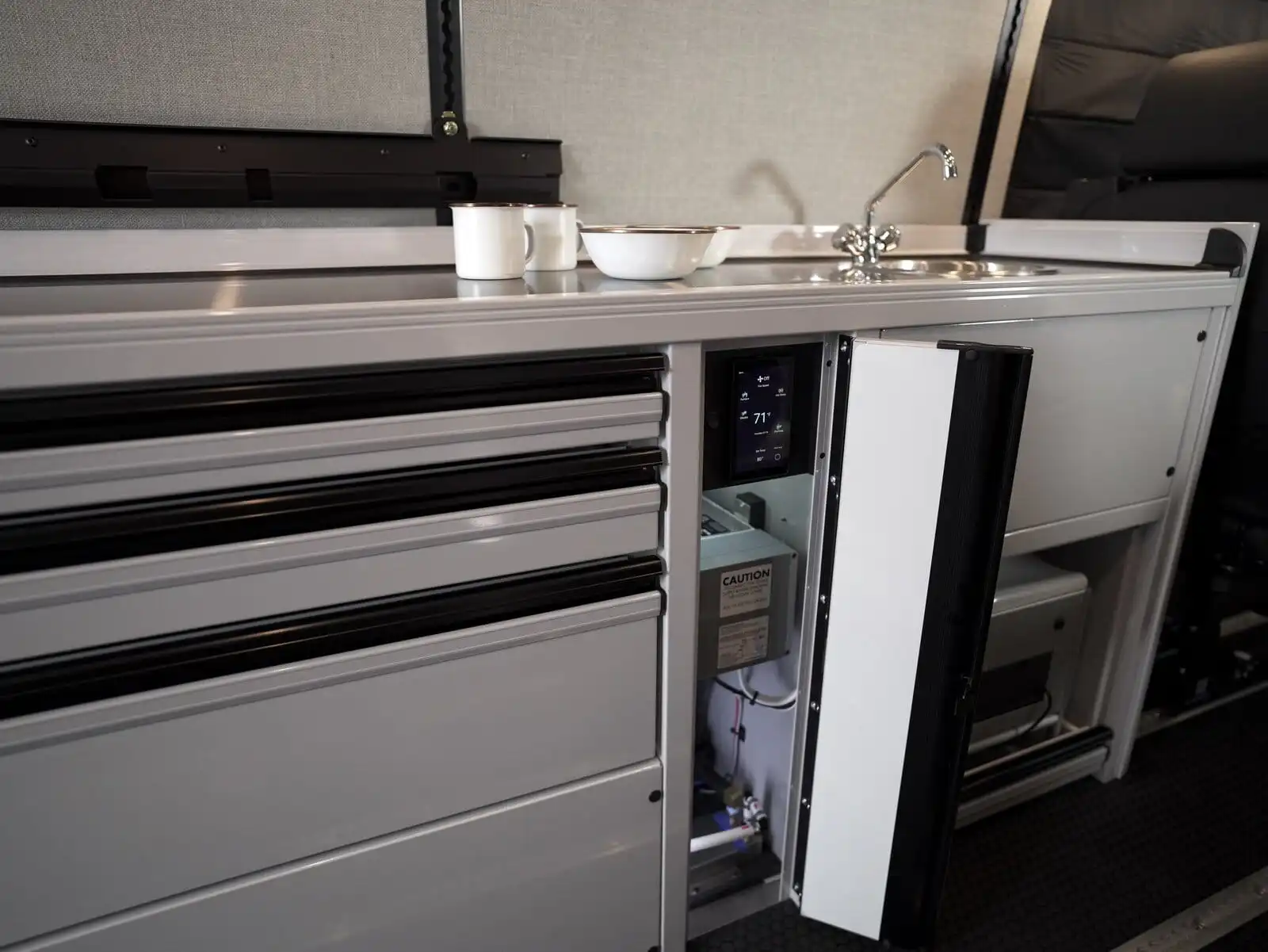
The galley-forward layout prioritizes a real kitchen — counter space, a larger fridge, proper cooking — for travelers who spend serious time cooking inside. It trades some sleeping or storage space for a functional galley.
The open / modular layout minimizes fixed furniture in favor of reconfigurable seating and storage, often on a system like Smartfloor. It’s the most adaptable pattern — the same van becomes a sleeper, a cargo hauler, or a passenger vehicle depending on the day — which is why it suits owners whose travel changes from trip to trip.
Sprinter length and roof matter as much as the plan
A floor plan is only meaningful in the context of the van it sits in. The Sprinter comes in different wheelbases and roof heights, and those dimensions set the envelope every layout works within. A longer wheelbase gives a fixed bed and a galley room to coexist; a shorter one forces sharper trade-offs. A high roof makes standing height and overhead storage possible; a standard roof changes the whole interior feel. Choosing the chassis and the layout together — rather than picking a plan and forcing it into the wrong van — is how you avoid a build that feels cramped or compromised. We work the chassis and layout decisions in parallel for exactly this reason.
Why modularity beats picking the “perfect” plan
The hardest part of choosing a floor plan is that your needs will change. The couple buys bikes, the family adds a kid, the weekend traveler starts working from the road. A fixed layout optimized perfectly for today can become a poor fit in two years. That’s the case for building modularity into the floor plan from the start: a system like Smartfloor lets seating and modules move or come out entirely, so one van can shift between configurations as life does. You’re not betting the whole build on predicting your future perfectly — you’re building in the ability to adapt. We cover how that works in our guide to modular Sprinter interiors and the decision between integrated and kit modular systems.
How we approach layout in a custom build
In a Patrol Vans build, layout is a conversation before it’s a drawing. We start with the use case, identify the two or three layout patterns that fit, and then work through the trade-offs honestly — including the ones a buyer might not anticipate, like how a fixed bed affects standing room or how a galley-forward plan changes storage. The goal is a configuration the owner will still be happy with after a year of real trips, with enough built-in flexibility to absorb the changes none of us can fully predict. The model pages for the AlphaVan, EchoVan, and OmegaVan show how those layout philosophies play out across different build sizes.
Frequently asked questions
What’s the best Sprinter van floor plan? There isn’t one — the best layout is the one that matches how you travel. A gear-hauler wants a fixed bed with a garage; a family wants convertible or modular seating; a cook wants a galley-forward plan. Define the use case first and the right plan follows.
Can a Sprinter layout seat passengers and sleep them too? Yes — convertible dinette/bed and modular layouts are designed for exactly that, adding seatbelted seating that converts to sleeping space. Fixed-bed layouts usually trade passenger seating for a permanent bed.
How much does wheelbase affect the floor plan? A lot. A longer wheelbase lets a fixed bed and a full galley coexist; a shorter one forces tighter trade-offs. Choose the chassis and the layout together rather than forcing a plan into the wrong van.
Can I change my van’s layout later? With a modular system like Smartfloor, substantially yes — seating and modules can move or come out. With a fully fixed build, changes mean significant rework. That’s the main argument for building modularity in from the start.
Should I copy a layout I saw online? Use it as inspiration, not a template. A plan that works beautifully for someone else’s travel style can be a poor fit for yours. Start from your own use case and adapt patterns to it.
Where to go from here
If you’re working out a floor plan for your own build, the most useful next step is to map your real use case — passengers, sleeping, gear, trip length, cooking — and let the layout follow. Explore modular Sprinter interiors, compare modular system approaches, look at how layout varies across the AlphaVan, EchoVan, and OmegaVan builds, or talk with the Patrol Vans team about a configuration that fits how you travel.
External reference: Mercedes-Benz Vans for Sprinter dimensions and wheelbase options.