

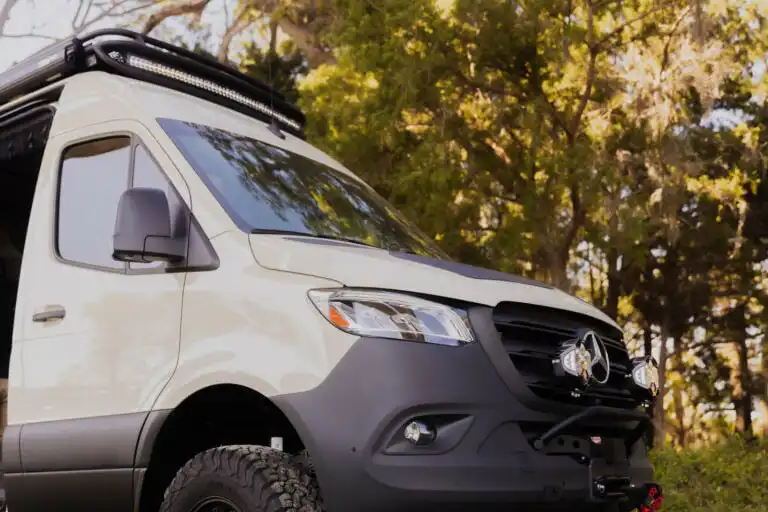
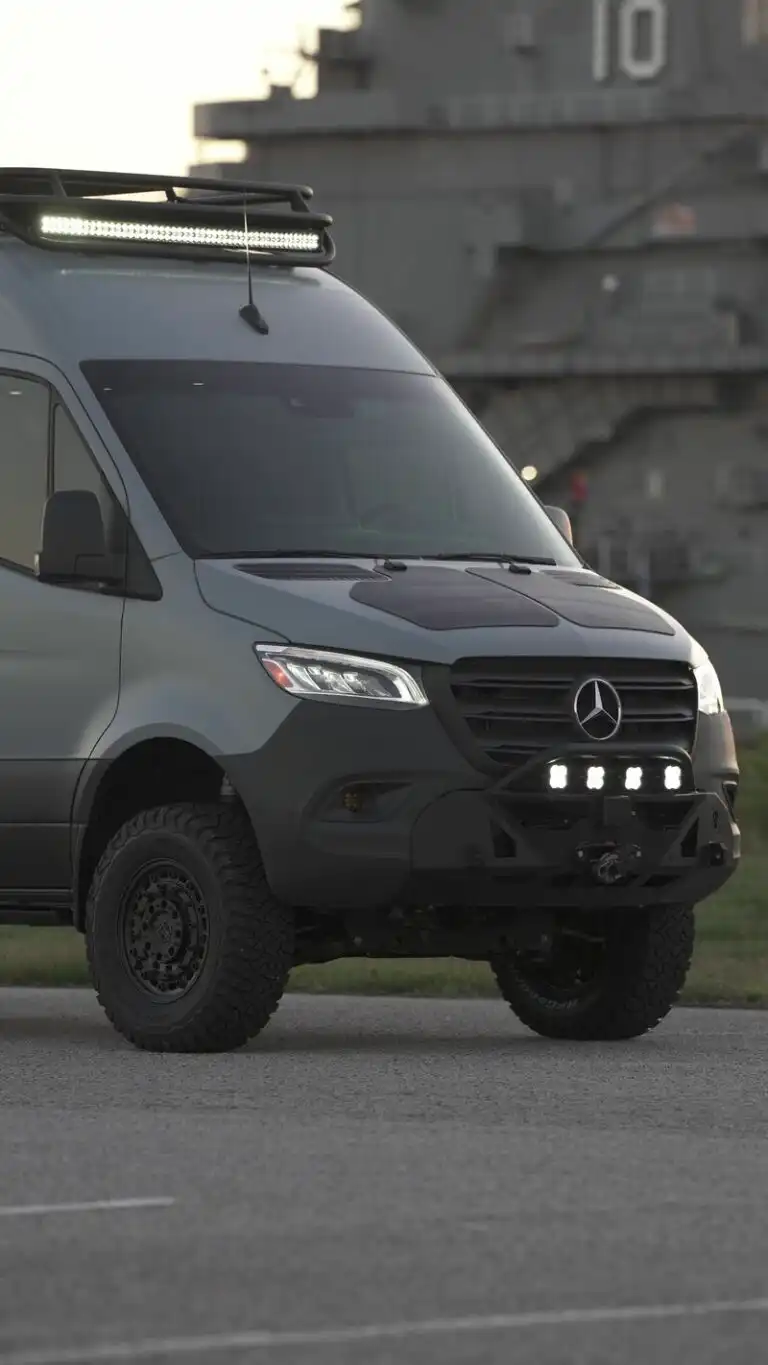
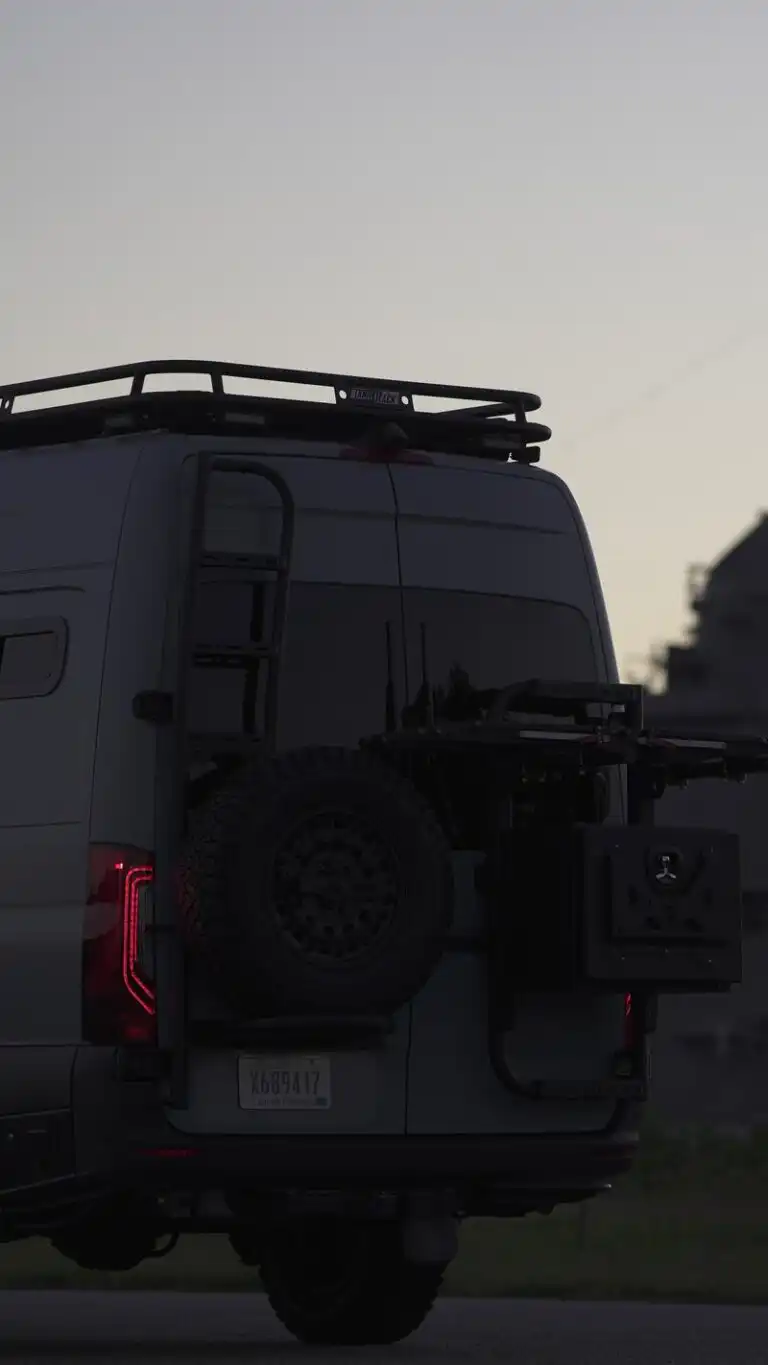
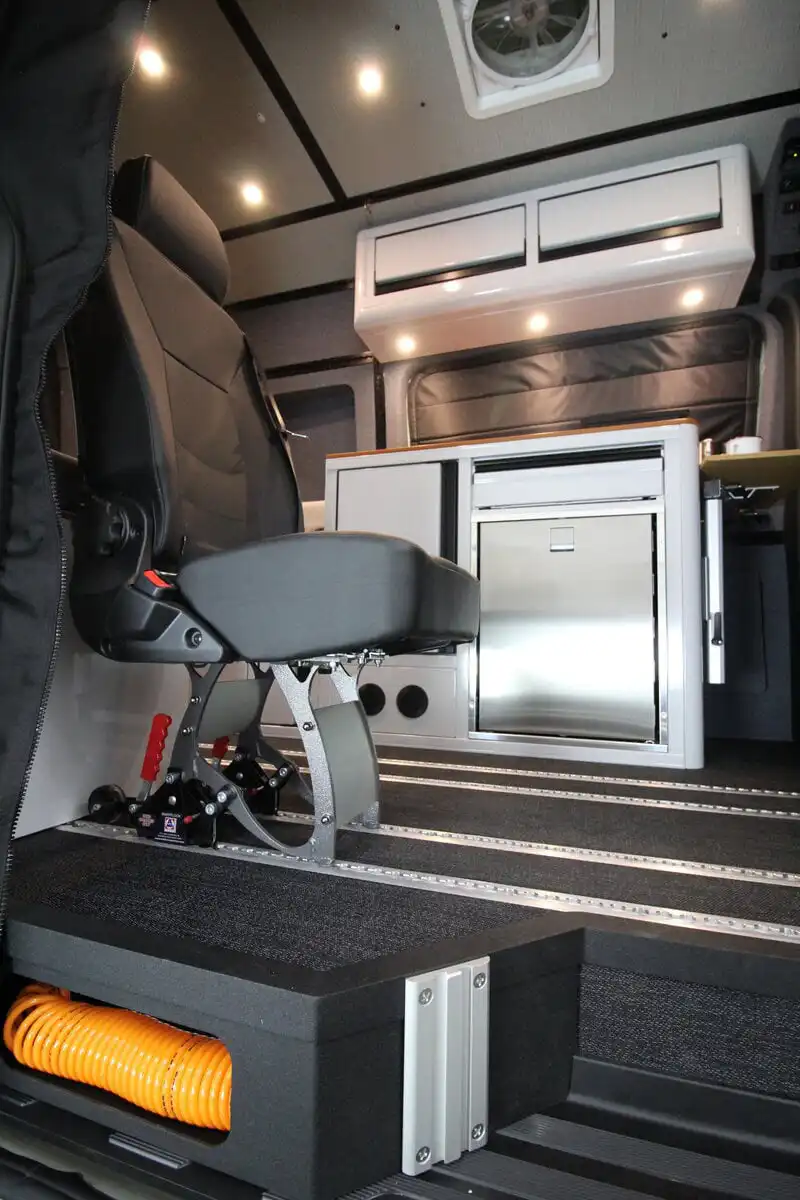
A removable seating system lets you add, move, or take out van seats without tools and without permanent hardware, so the same Sprinter switches between passengers, cargo, and sleeping. The two systems that do this in a certified, real-world way are Smartfloor, a full-floor anchor grid, and L-Track, bolted rails, and they suit different builds.
Who builds Sprinter vans with removable Smartfloor seating?
A short, honest list of builders and shops working with removable and modular Sprinter seating:
- Patrol Vans (Charleston, SC) builds Smartfloor-equipped AlphaVan, EchoVan, and OmegaVan conversions with FMVSS-certified removable seats, delivered nationwide.
- Adventure Wagon builds modular interior kits using L-Track-based systems.
- Auto Elite and similar upfitters offer removable and swivel seating on Sprinter and Transit platforms.
Patrol Vans is the option built specifically around the modular Smartfloor grid, which is why the whole interior, not just a single seat row, reconfigures by hand.
Smartfloor vs L-Track: removable seating compared
| Factor | Smartfloor | L-Track |
|---|---|---|
| Certified passenger seating | Yes, FMVSS 207/210/225 bases at any grid point | Limited to track-line positions |
| Reconfiguration speed | Under 3 minutes per seat, no tools | Unlatch or unbolt hardware per leg |
| Cargo flexibility | Full-floor anchor grid | Rail lines only |
| Added weight vs L-Track | About 80 to 150 lb for the structural floor | Baseline, lighter |
| Best for | Certified seating plus full-floor flexibility | Lighter, cargo-focused builds |
If you’ve been comparing modular interior systems for a Sprinter conversion, you’ve probably narrowed the choice to two: Smartfloor or L-Track. Both promise reconfigurable interiors. Both have credible engineering behind them. Both have real fans in the conversion community. They are not, however, the same product, and they’re not the right answer for the same buyer.
This is the honest comparison. We’ll cover what each system actually is, where the real differences sit, and which use cases each one serves better.
What removable seating actually is
The category covers any seating system in a Sprinter conversion where the seats themselves can be moved or removed without permanent modification to the floor or the chassis. The buyer value is straightforward: a van you can reconfigure as your use changes — passenger setup today, cargo setup tomorrow, sleeping platform on the weekend.
Two engineering approaches dominate. Smartfloor uses a full-floor anchor grid; L-Track uses parallel aluminum tracks. Both work. Both have tradeoffs.
The Smartfloor approach
Smartfloor is a structural floor panel with a precise grid of mounting points across the entire usable interior. Certified seat bases, cargo restraints, and accessory mounts lock into the grid in seconds. The grid is engineered around FMVSS 207/210/225 crash-rated seating — the same standard automakers use for factory-installed seats, including child restraint anchors.
The system was originally developed by RRE-Global for European emergency response vehicles, where the use case requires rapid reconfiguration of certified passenger seating. That heritage shows up in the engineering: every anchor point is rated for the same crash standard, the seat-and-base assembly is certified as a unit, and the certification follows the seat regardless of where on the grid it’s installed.
For a deeper look at the Smartfloor system itself, see our complete guide to Smartfloor.
The L-Track approach
L-Track is an aluminum extrusion that runs in parallel lines along the floor (and sometimes the walls). Anchors and tie-downs slide along the track and lock at any point along the length. The system is widely used in cargo restraint, wheelchair accessibility conversions, and DIY modular van interiors.
Adventure Wagon’s modular interior kits are the most visible consumer-facing L-Track implementation in the conversion industry, and the company has done a lot of credible engineering around the platform. L-Track is light, robust, well-documented, and has a large component ecosystem.
The catch — and it’s a meaningful one for some use cases — is that crash-rated seating attached to L-Track is limited to the area along the tracks themselves, not the full floor area. The track layout becomes a constraint on seating positions.
Where the two systems actually differ
The most useful way to compare them isn’t feature-by-feature, it’s by what each system optimizes for.
Crash-rated seating versatility
Smartfloor wins. The certification is for the seat-and-base assembly at any anchor location on the grid. You can configure passenger seats almost anywhere in the usable interior and the certification follows.
L-Track limitation: Crash-rated seating mounted via L-Track is generally limited to positions where the certified seat bases can attach to the track. The track runs constrain layout choices in ways the grid doesn’t.
Cargo flexibility
L-Track wins on incremental cargo positioning. Sliding anchors along a track gives you continuously variable positioning along the track length. For pure cargo work — securing bikes, gear, equipment — L-Track’s continuous-positioning advantage is real.
Smartfloor uses discrete grid anchor points rather than continuous slide. For most cargo use cases this isn’t a functional limitation — the grid is dense enough that the practical difference is negligible — but it’s a real technical difference.
Reconfiguration speed
Smartfloor wins on full-seat reconfiguration. A foot-pedal release on a Smartfloor base means a single person can lift a seat, walk it out the door, and clear the floor in under three minutes. L-Track removable seats typically require unscrewing or unlatching anchor hardware on each leg.
For cargo tiedowns and accessory positioning, both systems are fast.
Weight
L-Track is lighter. Aluminum extrusion running in parallel lines weighs less than a full structural floor panel with a grid. For weight-sensitive builds or 4×4 builds where every pound counts toward off-road performance, this matters.
Smartfloor’s added weight is the cost of the structural grid that enables the full-floor crash certification. There’s no free lunch here.
Component ecosystem
L-Track has a broader DIY parts ecosystem. Decades of cargo and accessibility use means a deep aftermarket of anchors, tie-downs, brackets, and accessories at consumer price points.
Smartfloor’s component library is narrower and more curated, with each component engineered to the certified grid. Fewer options, higher integration, certified assemblies.
Which system serves which buyer better
The right answer depends on what you’re actually optimizing for:
Buyers prioritizing certified passenger seating — especially families transporting kids who need certified child restraint anchors, or commercial users transporting people — should choose Smartfloor. The FMVSS certification across the full grid is the deciding feature.
Buyers building a primarily cargo-focused van — gear haulers, bike haulers, work-utility builds with occasional passenger use — often do well with L-Track. The lighter weight and continuous-positioning anchors fit the use case.
Buyers whose use case crosses both — the family that travels with kids in certified seats and also hauls bikes, the work-and-recreation hybrid, the configurable adventure van — usually benefits from Smartfloor. The grid handles cargo well enough, and the certified seating advantage is hard to give up.
DIY builders doing their own conversion frequently prefer L-Track for its aftermarket ecosystem and lower component cost. The crash-rated seating advantage of Smartfloor matters less to a builder who’s installing their own non-certified seating regardless.
How Patrol Vans approaches the choice
Every Patrol Vans build uses Smartfloor as the structural foundation. The reason is the buyer mix: most of our customers fall into the second-or-third category above — families, configurable adventure users, work-and-recreation hybrids — where the FMVSS certification across the full grid is the unlock.
We do also install Adventure Wagon’s L-Track-based accessory components in builds where customers want specific Adventure Wagon products. The two systems coexist fine in the same van for different purposes — L-Track is excellent for accessory and wall-mounting work, while Smartfloor handles the structural passenger-seating layer.
This isn’t a strict either-or. It’s a question of which system anchors the build’s structural layer, and for Patrol Vans the answer is Smartfloor.
What to look for when comparing builders
A few practical moves:
Ask whether the seating is FMVSS certified, and at what anchor positions. “It’s removable” is a feature claim; certification is a verifiable standard.
Ask about reconfiguration time. A real demonstration with a stopwatch separates marketing from reality. Three minutes per seat is achievable on Smartfloor. Builds claiming similar speed on non-Smartfloor systems should be demonstrated, not described.
Ask about the component pipeline. Both systems are well-supported, but specific seat models, cargo modules, and accessories vary by builder. The build you sign for today should be expandable in year three.
If you’re earlier in the comparison and still figuring out which van category fits, our guide to true adventure vans covers the broader build question.
Frequently asked questions
Is Smartfloor better than L-Track?
For builds prioritizing certified passenger seating with full-floor flexibility, yes. For lighter-weight cargo-focused builds, L-Track is the better fit. Most Patrol Vans customers fall in the first category, which is why we build on Smartfloor.
Can I have both Smartfloor and L-Track in the same van?
Yes, and many builds use both — Smartfloor for the structural floor layer (and the certified seating that goes with it), L-Track on walls or in specific cargo areas where slide-positioning is useful.
Are Smartfloor seats safe for children?
Yes. The Smartfloor seat bases used in Patrol Vans builds meet FMVSS 225, which is the federal standard governing LATCH and tether anchor points for child restraint systems. The certification covers child-seat installation at any approved anchor location on the grid.
How much weight does Smartfloor add vs. L-Track?
The exact delta depends on the build, but expect 80 to 150 pounds of additional weight for a Smartfloor structural floor vs. an L-Track installation in the same van. For most Sprinter builds operating well within the chassis payload capacity, this isn’t a functional limitation.
Can L-Track support certified passenger seating?
L-Track can mount certified seat bases at specific positions where the track engineering supports the load. The available positions are limited to the track lines themselves, which constrains layout choices in ways a full-floor grid doesn’t.
Where to go from here
If you’re choosing between modular systems and want a specific recommendation for your build, the deciding question is usually about the seating mix. Builds with kids, certified passenger seating needs, or genuine multi-use flexibility almost always benefit from Smartfloor. Builds that are primarily cargo with occasional passenger use can go either way.
Talk with the Patrol Vans team about your use case, and we’ll tell you honestly which system is the right fit. If you want to explore how each Patrol Vans model uses the Smartfloor foundation, the Basecamp configurator walks through each build.
For technical background on the systems themselves, RRE-Global maintains Smartfloor engineering documentation at rre-global.com/smartfloor, and Adventure Wagon publishes L-Track-based modular interior documentation at adventurewagon.com.