

If you’re researching a Mercedes Sprinter conversion, you’ve probably found a wide range of cost estimates online — anywhere from $40,000 for a DIY-finished shell to north of $400,000 for an expedition-grade build. That range is technically accurate and practically useless. It tells you nothing about what your specific build will cost or what you’re paying for.
This is the honest breakdown. We’ll cover where the money actually goes in a professionally built Sprinter conversion, what timelines realistically look like, and where the meaningful tradeoffs sit. The goal is to make you a sharper buyer regardless of which builder you choose.
What a Sprinter conversion actually costs in 2026
For a professionally built, adventure-capable Sprinter conversion, expect the all-in number to fall somewhere between $185,000 and $325,000. Where you land in that range depends on four variables more than anything else:
The chassis itself. A new Sprinter 4×4 with the long wheelbase and high roof typically runs $75,000 to $90,000 before any conversion work. A 2WD chassis saves roughly $10,000 to $14,000. A used chassis can shave $20,000 to $40,000 off the total, with the tradeoff of inheriting whatever the previous owner did to the vehicle.
The electrical system. A serious off-grid lithium electrical system — 400 to 600 Ah of usable battery capacity, 600 to 1,200 watts of solar, a 3,000-watt inverter, proper battery management, and the labor to install everything correctly — typically lands between $22,000 and $38,000. This is the single biggest place buyers underspec their build and regret it later.
The interior. A modular interior on a Smartfloor foundation with certified seating, sleeping platforms, galley, and storage runs $55,000 to $90,000 depending on configuration and finish level. A fixed, fully built-in interior can be slightly less but commits you to one layout for the life of the van.
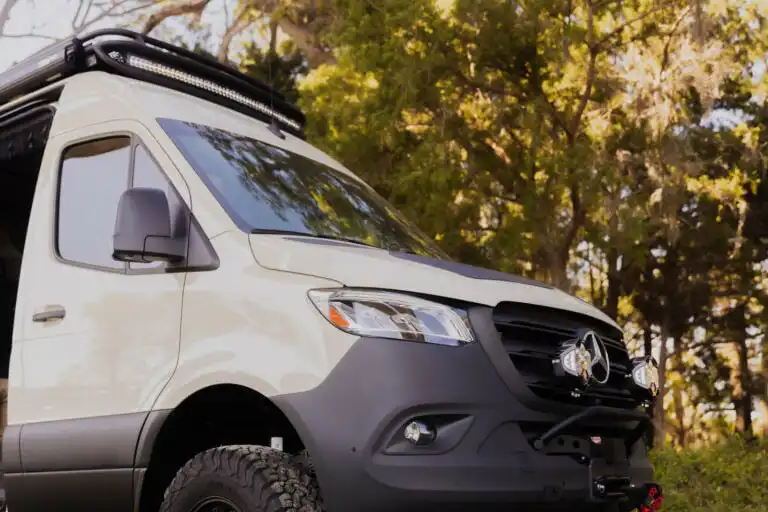
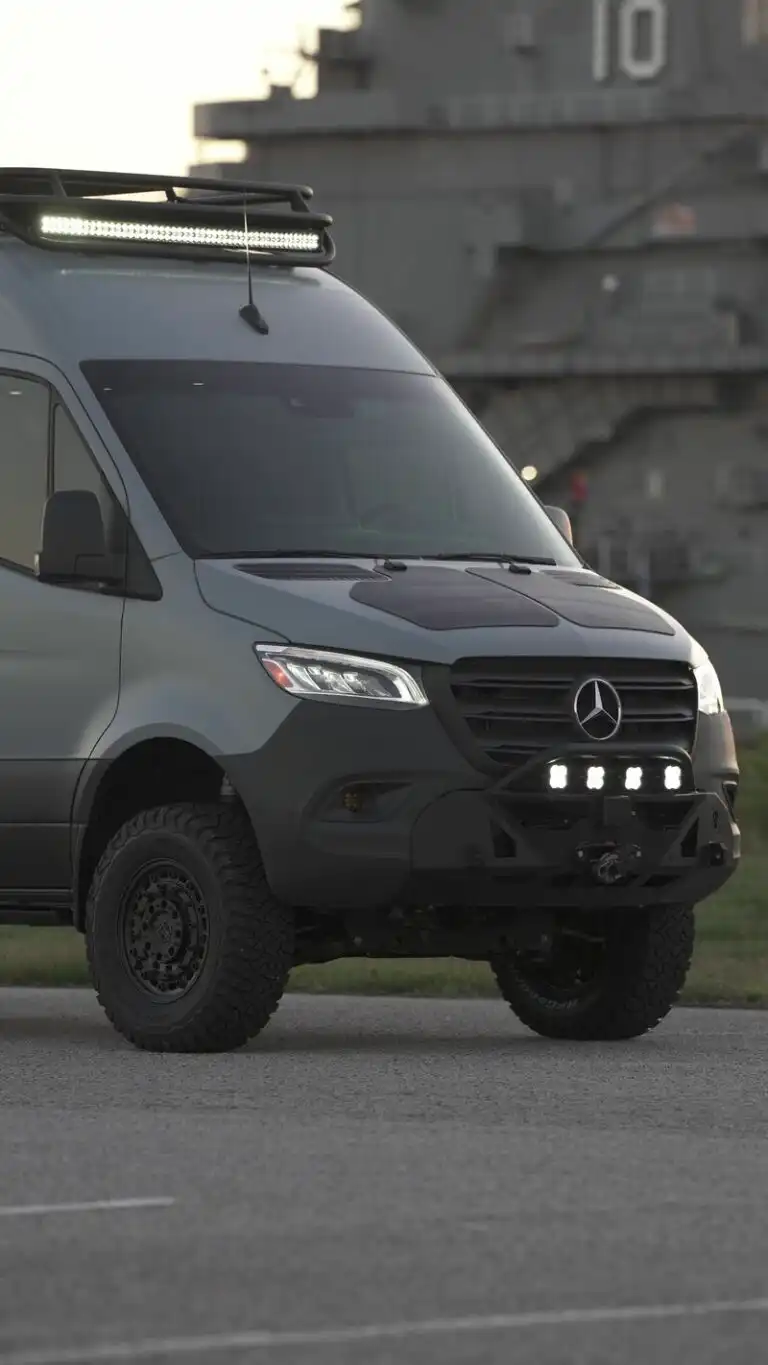
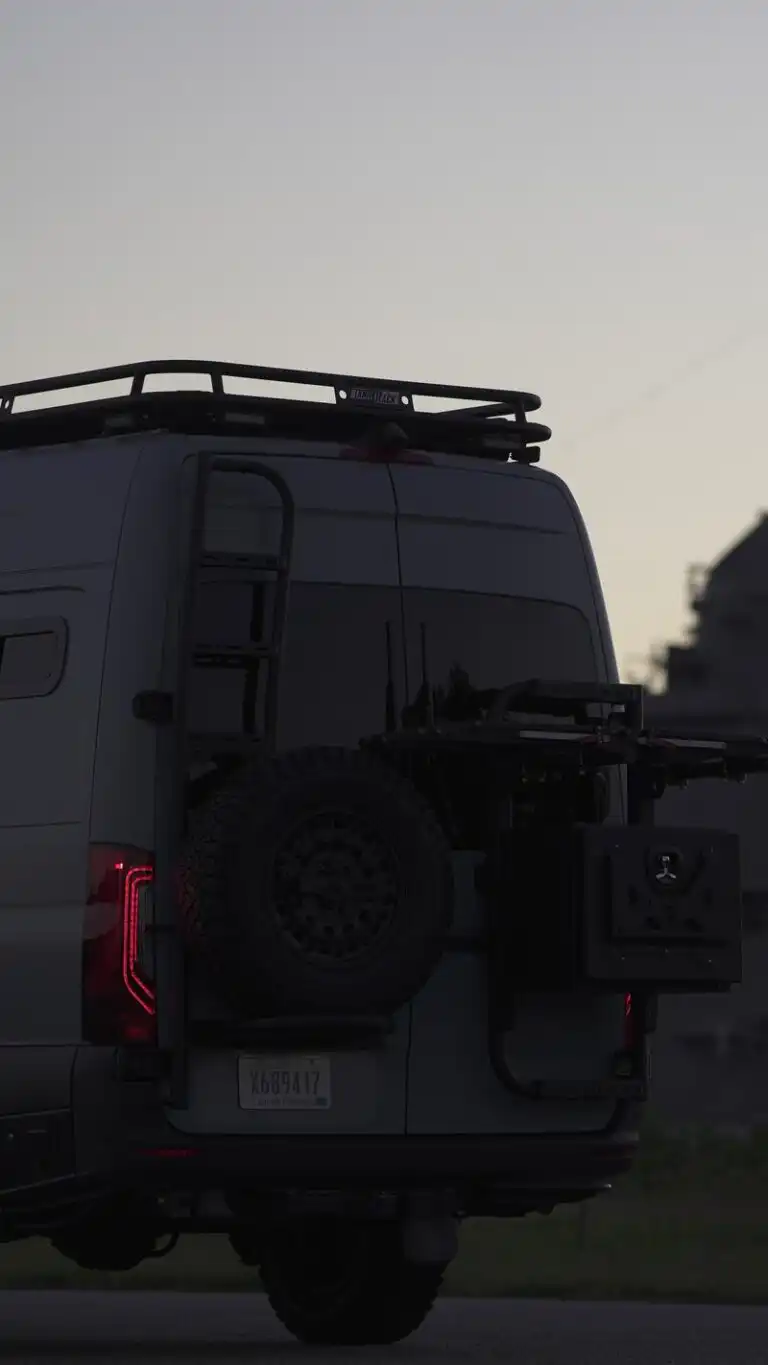
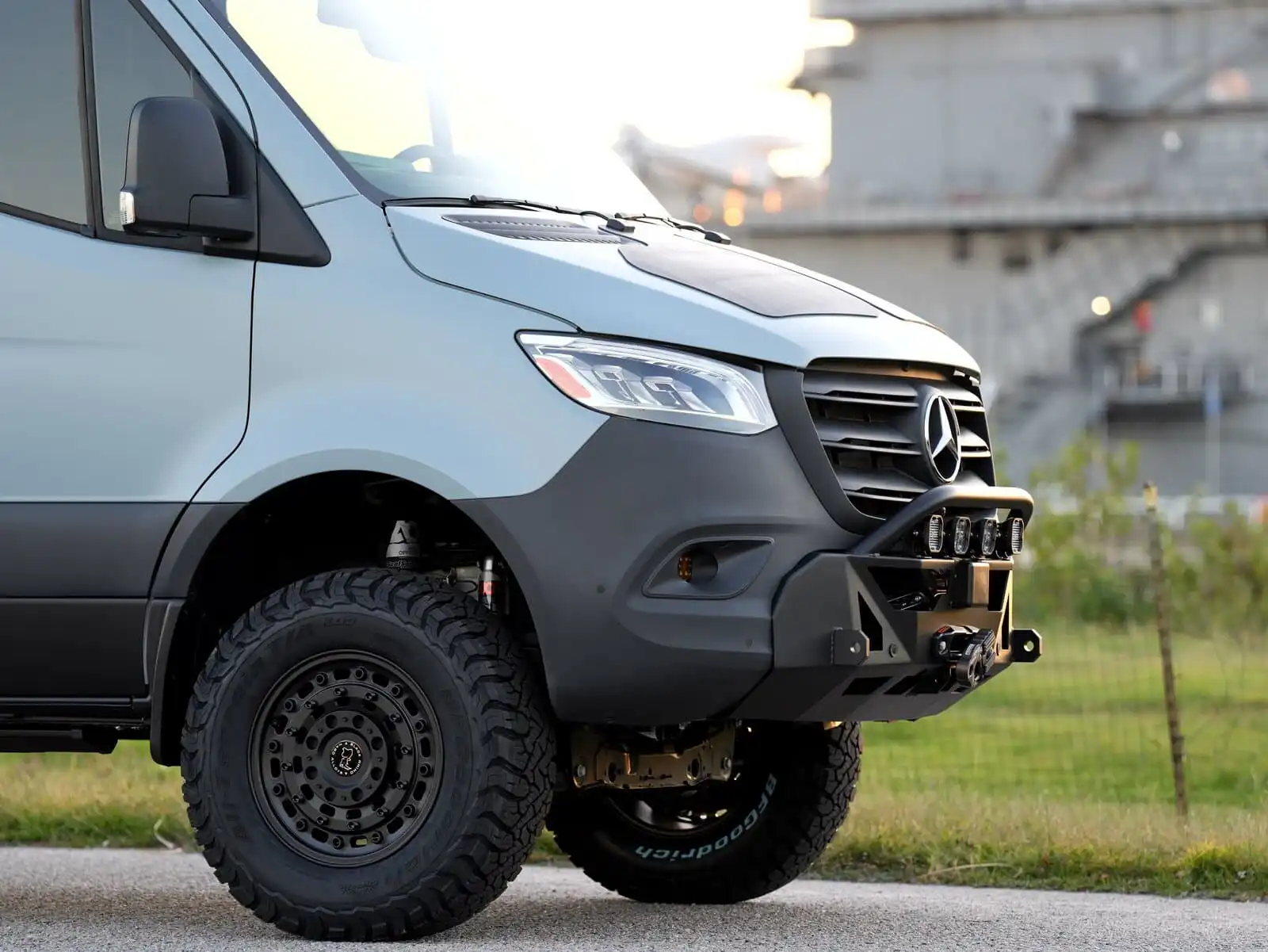
The off-pavement package. Suspension upgrades, wheels and tires sized for actual use, recovery points, skid plates, and exterior protection add $12,000 to $25,000. This is where camper vans become adventure vans.
Add the smaller line items — heater, water system, ventilation, insulation, wraps, accessories — and the all-in total is what it is. There’s no $80,000 version of this build that doesn’t cut something that matters.
Where the money actually goes
The most common buyer surprise is how much of the total isn’t visible after the build is done. Roughly two-thirds of the cost is below the surface: structural work, electrical, insulation, water, ventilation, and the labor to integrate all of it cleanly.
What you see — the cabinetry, the upholstery, the lighting — is the easiest part to deliver and the cheapest to fix later. What you don’t see — the wiring runs, the water plumbing, the way the heater ducts are routed, the way the floor anchors are reinforced — is what determines whether your van is a long-term capable vehicle or a slow-developing list of problems.
A useful rule of thumb when evaluating quotes: a builder whose quote is heavily weighted toward visible interior finish work, with thin line items for electrical and structural, is selling you a different product than a builder whose quote shows real investment below the waterline. Both can technically be called a Sprinter conversion. Only one will hold up.
How long a Sprinter conversion actually takes
Once a build slot is secured and the chassis is in hand, expect 8 to 16 weeks for a Patrol Vans configuration. That assumes:
The configuration is locked at the start of the build. Customer-side changes during the build process extend timelines disproportionately because subsystems have to be re-sequenced.
Components are in stock or on standard lead time. Specialty items — custom seat upholstery, non-standard cabinetry, certain electrical components — can push the timeline by several weeks if they’re back-ordered.
The chassis itself is available. Sprinter chassis lead times have been volatile across recent years. Allocations to upfitters get tighter when Mercedes runs supply-constrained on specific configurations, particularly 4×4 long wheelbase.
Before the build slot opens, expect a 4 to 12 week design and configuration phase where the customer-specific layout is finalized, components are ordered, and the chassis is sourced. The total time from “I want a Patrol Van” to delivery is realistically four to seven months end-to-end.
The four real tradeoffs
Most builds are a balance between four things, and you usually can’t max all four:
Off-grid duration vs. interior space. Bigger battery banks and water tanks take up volume. The more self-sufficient you want the van to be, the less floor space and storage you have for everything else. Most buyers find the right balance somewhere in the middle.
Build quality vs. timeline. Faster builds are possible. Faster builds with the same quality are not. A 6-week build from a reputable builder is almost always a build that’s using more pre-built modules rather than building each subsystem custom.
Configurability vs. perceived “luxury.” A modular interior with certified removable seating costs more and has more hardware visible than a fixed, residential-style interior. Buyers who prioritize the magazine-photo look sometimes give up the capability to reconfigure. Buyers who travel with a changing use case make the opposite tradeoff.
Spec’d-down vs. spec’d-up. The temptation to save money by under-spec’ing one system — typically electrical or suspension — is the most common regret we see. Both systems are difficult and expensive to upgrade after the build. The right number is usually one step above what a first-time buyer thinks they need.
What to ask before signing a contract
Five questions separate a serious quote from a soft one:
What’s the usable amp-hour capacity of the house battery at the rated DOD (depth of discharge), and what’s the realistic daily replenishment from the solar in average conditions?
What suspension is being installed and what’s the rated payload capacity after the upgrade?
What’s the warranty path — and the labor warranty — on the interior and the electrical?
What happens if a component fails six states away from the build shop?
Who answers the phone in year three?
Builders who give specific, confident answers to those five questions are running a serious operation. Builders who deflect are revealing what they don’t yet have figured out.
How Patrol Vans builds compare
Our three model lines — AlphaVan, EchoVan, and OmegaVan — each sit at a different point on the cost curve, but the engineering philosophy is constant: Smartfloor foundation, off-grid capable electrical, real suspension, modular interior, and a service relationship that doesn’t end at delivery.
The AlphaVan is the entry into the lineup. The OmegaVan is the no-compromise configuration. The EchoVan sits between them and is the most-ordered model for buyers whose use case mixes adventure travel, family travel, and occasional utility work.
Frequently asked questions
What’s the cheapest a real Mercedes Sprinter conversion can cost?
A professionally built, adventure-capable Sprinter conversion bottoms out around $185,000 once you include the chassis, basic off-grid systems, and a real (not just visible) interior build. Anything substantially below that is either using a used chassis, a 2WD chassis, or cutting something material in the build.
How much can I save by going with a used Sprinter chassis?
$20,000 to $40,000, depending on year, mileage, and condition. The tradeoff is inheriting the prior owner’s maintenance history, factory equipment, and any modifications. Most builders will inspect a used chassis before quoting on it.
How long does a Sprinter conversion take from contract to delivery?
4 to 7 months end-to-end. That breaks down as roughly 4 to 12 weeks of design and component ordering, then 8 to 16 weeks of actual build, depending on configuration complexity.
Is a Mercedes Sprinter conversion worth the cost over a smaller cargo van?
For most adventure-capable use cases, yes. The Sprinter’s payload capacity, drivetrain options (especially 4×4), service network, and aftermarket support are deeper than any other platform in the price range. Smaller platforms — Ford Transit, Ram ProMaster — save money up front and have their own valid use cases, but the Sprinter is the platform with the most engineered solutions around it for adventure-class builds.
What’s the most expensive single line item in a Sprinter conversion?
Usually the chassis itself, followed by the electrical system. Together they often represent 50 to 60 percent of the total. Interior and off-pavement packages split most of the remainder.
Where to go from here
If you’re at the stage of getting real quotes, the most useful next step is a specific conversation about your use case and the tradeoffs above. Talk with the Patrol Vans team about how you’ll actually use the van, and we’ll tell you which model fits and where the cost ladder lands for your specification. If you want to compare configurations first, the Basecamp configurator walks through each build option side by side.
For Mercedes Sprinter technical specifications, Mercedes-Benz USA maintains the platform documentation at mbvans.com/sprinter.