



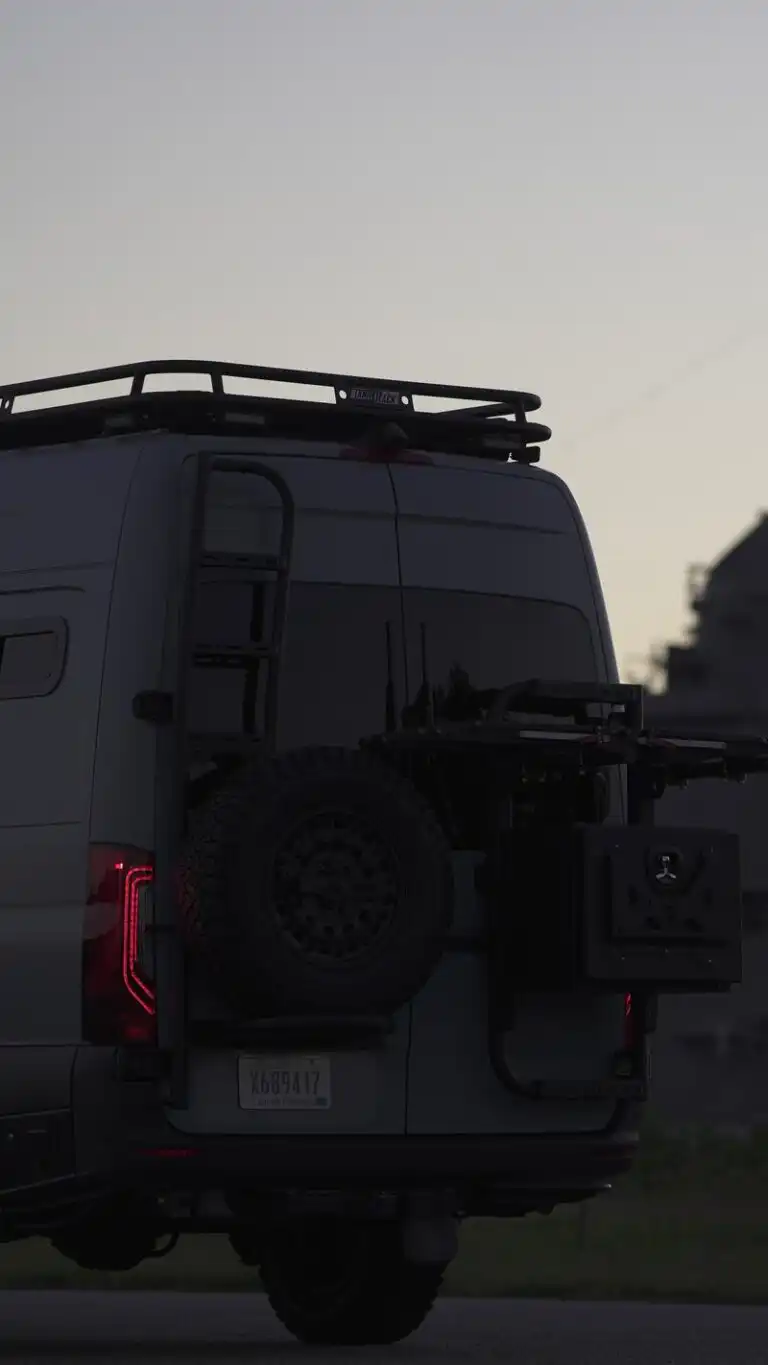
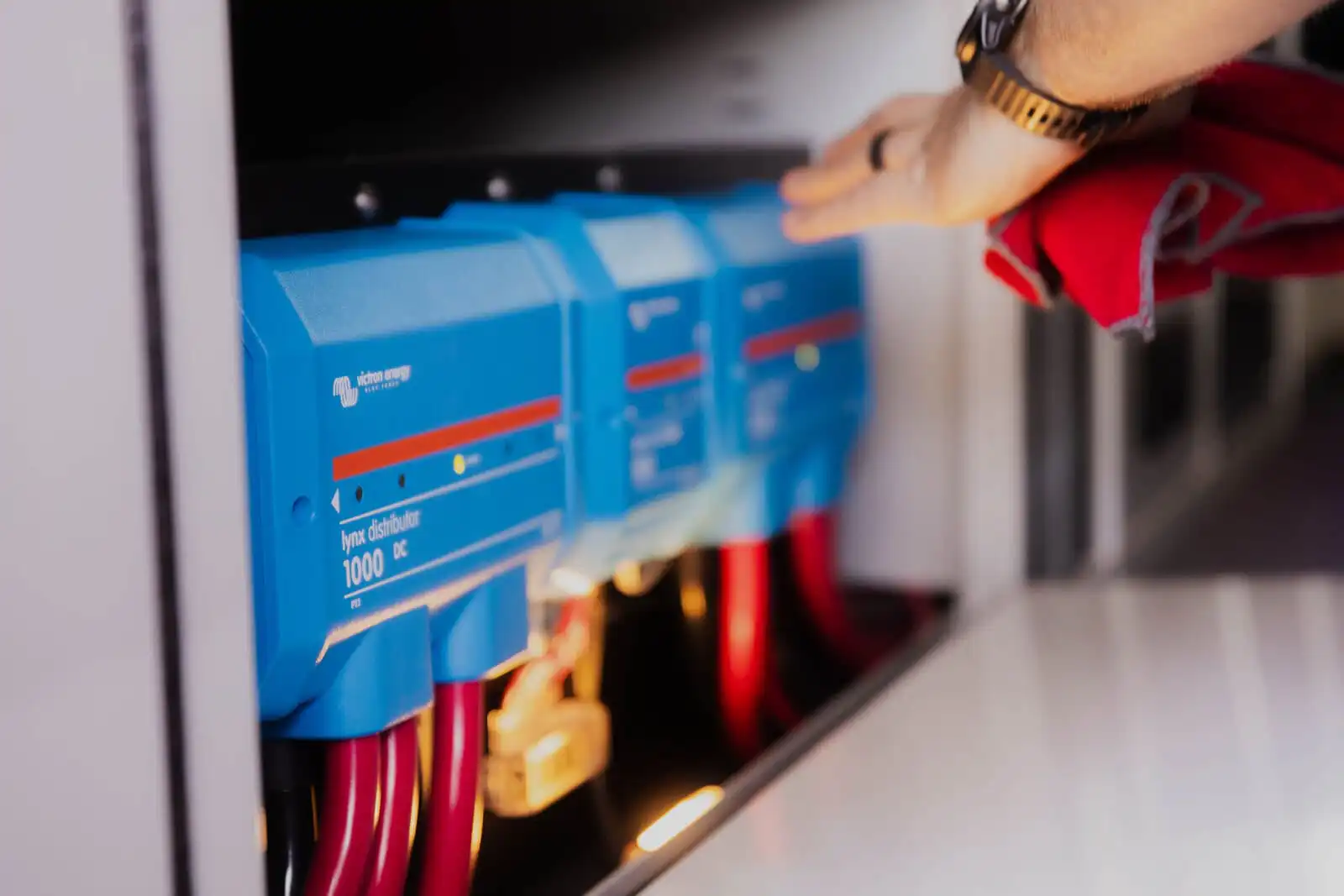
OmegaVan exists for the buyer whose van has to earn its keep. Mobile work, tools, comms, a mobile workshop, days on a remote job site, then a weekend that turns the same van into a basecamp — that dual-purpose demand is exactly what the OmegaVan electrical system is sized to carry. This article documents the OmegaVan electrical components, the sizing logic behind them, and the realistic capability of a utility-focused off-grid Sprinter build, in the detail buyers need to compare it honestly against lighter configurations.
For the broader design philosophy — why we standardize on Victron, how the components coordinate, and the rules we follow on every build — see our Victron electrical architecture hub. This article is the per-model deep dive for OmegaVan, the third in the model trio alongside the AlphaVan and EchoVan electrical guides.
OmegaVan electrical spec at a glance
The standard OmegaVan electrical specification:
- House battery bank: 600Ah LiFePO4 (12V nominal, ~7.68 kWh usable at 80% depth-of-discharge)
- Inverter / charger: Victron MultiPlus-II 12/3000-120-50 (3,000W continuous AC output, 50A AC pass-through)
- Solar: 800W+ roof-mounted array
- MPPT controller: Victron SmartSolar MPPT 150/85
- Alternator charging: Dual Victron Orion-Tr 12/12-30A DC-DC chargers (60A combined)
- Monitoring: Victron SmartShunt + Cerbo GX with GX Touch display
- Shore power: 50A inlet with integrated automatic transfer
Every OmegaVan ships with these components configured to coordinate through the Cerbo GX, so the system behaves as one managed architecture rather than a stack of independent boxes. The difference between OmegaVan and the lighter models is not the design language — it is the headroom.
Battery — 600Ah LiFePO4
600 amp-hours of LiFePO4 is the OmegaVan default, roughly 7.68 kWh of usable energy at the 80% depth-of-discharge we treat as the practical daily-cycling floor. That is triple the AlphaVan bank and 50% more than the EchoVan bank, and it exists for a specific reason: utility loads are spiky and unpredictable in a way that recreation loads are not.
A work build draws differently than an adventure build. Tools cycle hard for short bursts, comms gear runs continuously, and a mobile workshop can pull serious current with no warning. Sizing the bank for the average load would leave an OmegaVan owner managing power instead of working. The 600Ah bank is sized for the peaks, so the system stays invisible — which is the whole point of building it right.
Inverter / charger — Victron MultiPlus-II 12/3000-120-50
The MultiPlus-II 12/3000-120-50 is a fundamentally different chassis than the MultiPlus units in AlphaVan and EchoVan, not just a bigger number. The 3,000W continuous AC output handles real tool loads — a compact air compressor, corded power tools, an induction cooktop running while other appliances stay on. The 50A AC pass-through means that on shore power the OmegaVan can run the full site load through to internal systems while simultaneously charging the 600Ah bank, with no forced trade-off between charging and use.
The “-II” designation matters for utility builds: it supports external current sensing and more sophisticated power-assist behavior, so the inverter can blend battery and shore (or generator) power to cover a load spike that would otherwise trip a smaller supply. For a van that plugs into unpredictable power on job sites, that resilience is the feature buyers feel even if they never see it.
Solar — 800W+ on the roof, SmartSolar 150/85 MPPT
OmegaVan carries 800W or more of roof solar, paired with a Victron SmartSolar MPPT 150/85. “150” is the maximum input voltage and “85” is the maximum output current, which gives the larger array real charging headroom. In good summer conditions that array reliably harvests 160–240 Ah/day, enough to cover a heavy daily utility load and still bank surplus for the next cloudy stretch.
Roof real estate is the constraint on a utility build, because OmegaVan owners often want rack space for ladders, cargo boxes, or a workshop awning. We lay out the solar array and the rack hardware together at build time so neither compromises the other — a coordination problem that is far cheaper to solve before the roof is drilled than after.
Alternator charging — dual Orion-Tr 12/12-30A
OmegaVan runs two Victron Orion-Tr 12/12-30A DC-DC chargers in parallel — 60A of combined alternator charging. They isolate the lithium bank from the Sprinter’s alternator regulator (which is not designed for lithium chemistry and can shorten cell life without isolation) and provide a clean, fast charge path while the engine runs.
At 60A combined, a few hours of driving between sites puts a meaningful charge back into even the 600Ah bank — roughly 60 amp-hours per engine hour. For a work pattern that involves regular driving, the alternator becomes a primary recharge source rather than a backstop, which keeps the build productive on overcast weeks when solar harvest drops.
What this powers, realistically (use-case math)
The OmegaVan electrical system supports a demanding mixed-use profile without aggressive load management: an LED lighting kit, a 12V fridge running 24/7, a roof fan, continuous Starlink and cellular comms, a full remote-work setup with monitors, device charging for a crew, an induction cooktop, and intermittent corded tool use through the 3,000W inverter. With the 600Ah bank, that profile runs through the day and overnight with margin to spare.
Where even OmegaVan asks for planning: sustained high-draw resistive heating as a primary heat source, or running a residential-style air conditioner all night without solar or shore support. Those loads are possible, but they are a configuration conversation — we would talk through a diesel heater for primary heat and realistic AC runtime expectations rather than oversell the battery’s all-night capability. Being honest about that envelope is part of building a system the owner can actually trust.
Realistic off-grid capability with the standard OmegaVan electrical system: a full week of heavy mixed work-and-travel use when solar harvest and occasional driving keep the bank topped, and several days of genuinely heavy utility draw even with poor solar, before shore power or a generator is needed.
Where OmegaVan electrical sits vs AlphaVan and EchoVan
The architecture is identical across the three models — same Victron components, same Cerbo GX coordination, same monitoring story. Capacity and inverter class are the differences.
AlphaVan is the entry point: a 200Ah bank, 400W solar, a single Orion-Tr, and a MultiPlus 12/2000 sized for weekend-capable adventure use. EchoVan doubles the bank to 400Ah, doubles alternator charging, and steps the inverter to a MultiPlus 12/3000 — the configuration we design for week-long boondocking. OmegaVan tops the range with the 600Ah bank, dual Orion-Tr charging, the MultiPlus-II 12/3000-120-50, and 800W+ of solar, built for utility-heavy use where tools, comms, and workshop loads share the system with adventure travel.
If you are weighing which model matches your usage pattern, the model comparison guide covers the decision in detail.
Frequently asked questions
Can the OmegaVan electrical system run power tools? Yes — the 3,000W MultiPlus-II handles corded power tools, a compact air compressor, and an induction cooktop, the kinds of loads that define a work build. Very high continuous draws (large compressors, welding equipment) sit outside the design envelope and are a build-time conversation.
How long can OmegaVan run a full remote-work and comms setup off-grid? A continuous load of laptops, monitors, Starlink, and cellular comms typically draws 80–140 Ah/day. Against the 600Ah bank with 800W+ solar, that profile runs indefinitely in decent conditions and for several days even when solar is weak.
Is OmegaVan overkill for someone who just wants long off-grid trips? Sometimes. If the use case is recreation without heavy tool or comms loads, EchoVan’s 400Ah configuration is usually the better-matched build. OmegaVan earns its capacity when the van also has to be a workspace.
Can a generator integrate with the OmegaVan system? Yes. The MultiPlus-II’s pass-through and power-assist behavior is designed to blend a generator or shore source with battery power, which is useful for utility owners working extended stretches in low-sun conditions.
Does the larger bank change charging time from the alternator? The dual Orion-Tr setup puts roughly 60 amp-hours into the bank per engine hour. A larger bank takes longer to fill from empty, but most owners cycle the top portion daily rather than running the bank flat, so practical recharge stays quick.
Where to go from here
If the OmegaVan electrical envelope fits a work-and-adventure use pattern, the next step is the OmegaVan model page for full configuration options. To compare against the lighter builds, see the AlphaVan and EchoVan electrical guides, review the broader Victron architecture hub, or explore build options and talk with the Patrol Vans team about which configuration matches how you actually work and travel.
External reference: Victron Energy for component spec sheets.