

There is a specific moment that separates people who travel in three seasons from people who travel in four: waking at 3 a.m. in a van that has dropped to the outside temperature. Insulation slows that down. It does not stop it. Sooner or later a four-season build needs a heat source that runs all night without shore power, without draining the battery bank, and without putting moisture into the air. For a Sprinter, that almost always means a diesel heater — and the difference between one that quietly transforms cold-weather travel and one that becomes a recurring headache comes down almost entirely to how it is specified and installed.
This guide covers how diesel air heaters work in a van, how they compare to the alternatives, what separates a good install from a poor one, and how heating fits alongside the rest of a four-season build.
How a diesel air heater actually works
A diesel air heater draws a small amount of fuel from the van’s own tank, burns it inside a sealed combustion chamber, and uses that heat to warm cabin air blown across a heat exchanger. The critical detail is that the combustion circuit and the cabin air circuit never mix. Exhaust and combustion byproducts vent outside through their own line; the air circulated inside the van only passes over the outside of the exchanger. Nothing from the burn enters the living space.
Two consequences follow, and they are why this is the standard for serious cold-weather van travel. First, the heat is dry — no water vapour is added to the cabin, which matters enormously in a sealed, insulated van where condensation is the real enemy. Second, running costs are trivial. A diesel heater consumes a small fraction of a gallon per night while drawing modest power from the battery bank for its fan and controller, so a properly sized electrical system runs one overnight without meaningful impact.
Espar and Webasto: the two names that matter
Espar (Eberspacher) and Webasto are the two established manufacturers in this space, both with long histories in commercial trucking before van conversions adopted them. Both build genuinely reliable equipment, both offer air heaters in the output range a Sprinter conversion needs, and both are supported by real dealer and parts networks — which matters more than any spec-sheet comparison the first time a unit needs service somewhere unfamiliar.
The practical differences come down to control interfaces, altitude compensation behaviour, service network in the regions you travel, and how each integrates with the specific van. That is a build-level decision rather than a universal winner, and it is worth making with the shop rather than from a forum thread.
The category worth being direct about is the very inexpensive imported diesel heaters. They can work. They are also inconsistent in build quality, thin on genuine support, and — most importantly — frequently installed badly by people following videos rather than manufacturer specifications. In a professional four-season build we specify established equipment, because a heater is a combustion appliance running unattended while people sleep, and that is not a place to economise.
Why installation matters more than the brand
Most diesel heater problems we see are installation problems, not equipment problems.
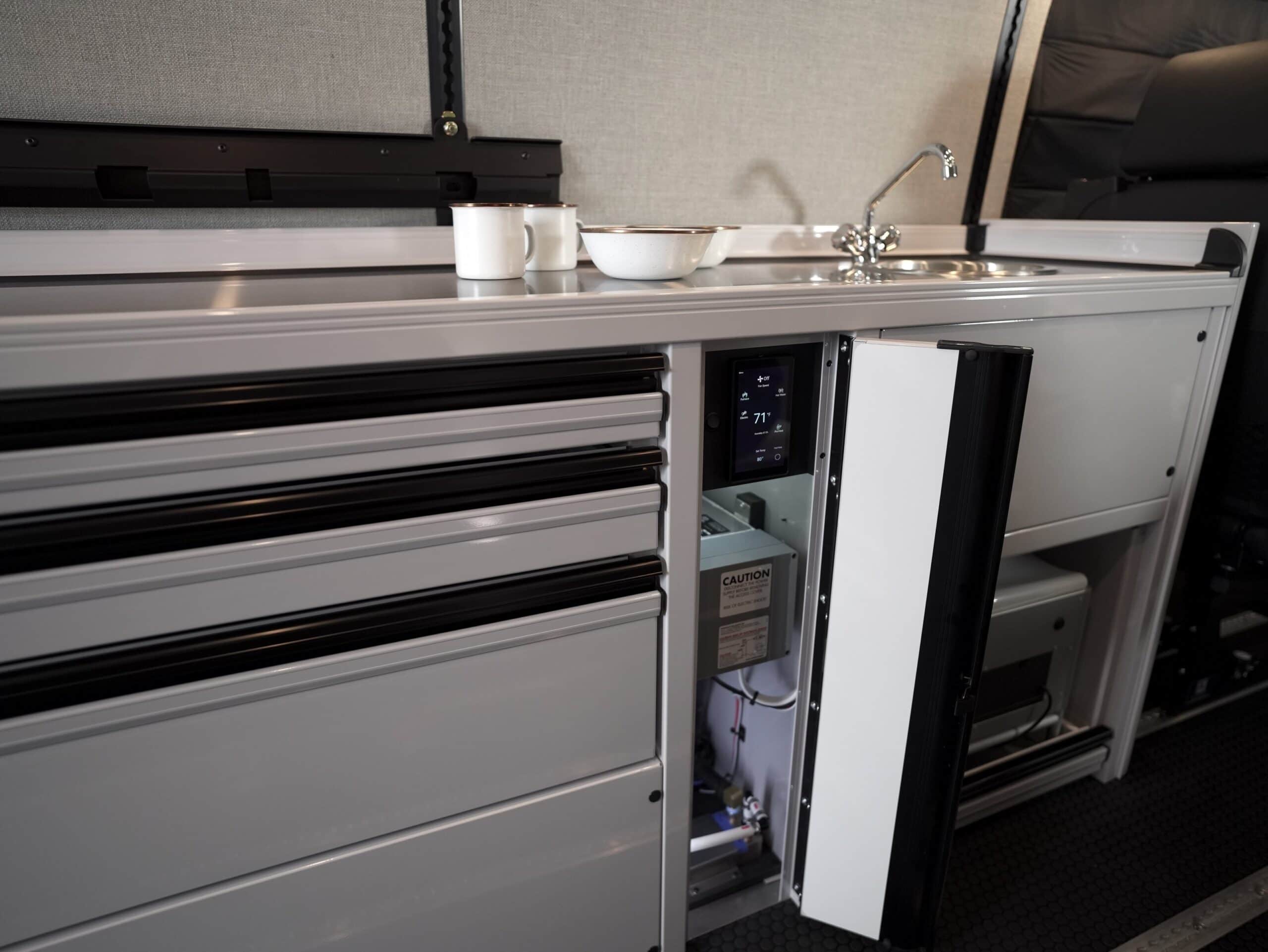
Fuel pickup has to be done properly — either a dedicated standpipe in the van’s tank or a manufacturer-approved tap, positioned so the heater cannot draw the tank down below the level the van itself needs. The metering pump has to be mounted at the correct angle and isolated, because a pump bolted rigidly to a panel transmits an audible tick through the whole van all night. Exhaust routing must terminate where fumes cannot be drawn back in — clear of windows, vents, and the fresh-air intake — and must be secured and heat-shielded away from anything vulnerable underneath. Combustion air intake has to draw from outside, protected from road spray and blockage.
Inside, ducting is what determines whether the van heats evenly or produces one hot corner. Runs should be as short and as straight as practical, with outlets positioned to move air along the floor and circulate it rather than blasting one bunk. And the whole system needs to be commissioned and tested under load, not just switched on once.
None of this is exotic. All of it is the difference between a heater you forget about and a heater you fight.
Heating is half of four-season capability
A heater compensates for heat loss. It does not prevent it, and a powerful heater in a poorly built envelope simply burns more fuel to lose the same warmth faster. The two halves have to be designed together: insulation and thermal-bridge control determine how much heat the van retains, and the heater determines how quickly it can replace what escapes. Get the envelope right and a modest heater holds a comfortable cabin through a cold night on very little fuel.
Ventilation is the third element, and the one people get wrong most often. Sealing a van tightly and then heating it produces condensation, because occupants generate moisture continuously just by breathing. Controlled ventilation — a small, deliberate air exchange — keeps humidity down and windows clear. The dryness of diesel heat helps considerably here compared with any combustion source vented into the cabin, but it does not remove the need for airflow.
Electrical planning is the fourth. The heater’s fan and controller draw modest but continuous power overnight, and winter is precisely when solar production collapses. A system sized on summer assumptions will disappoint in January. This is exactly the scenario our Victron-based electrical architecture is designed around, and it is why we size battery capacity for the worst week rather than the average one — the same logic behind boondocking for a week without plugging in.
What this changes about how you travel
The practical result of getting all four elements right is that cold stops being a planning constraint. Shoulder seasons open up. High-elevation trailheads stay usable into late autumn. Ski-season basecamps and winter hunting trips become a matter of preference rather than endurance. And the van stays dry, which protects the cabinetry, the insulation, and everything else you paid for.
That is the actual argument for four-season capability: not that you will camp in a blizzard, but that the calendar stops deciding where you can go. It is the same principle behind everything else in a genuinely off-grid capable van — capability measured in how long you can stay comfortable, not in how the van looks parked.
Frequently asked questions
Are diesel heaters safe to run overnight in a van?
A correctly installed diesel air heater is designed for exactly that. Combustion is sealed and vented outside, so exhaust gases never enter the living space, and cabin air only passes over the outside of the heat exchanger. Safety depends on correct exhaust routing, a proper fuel connection, and a working carbon monoxide alarm as a backstop — which every build should have regardless of heat source.
How much diesel does a van heater use per night?
A small fraction of a gallon for a typical overnight run, varying with output setting, outside temperature, and how well the van is insulated. Fuel consumption is rarely the constraint; a well-built van can run a heater on cold nights for weeks on fuel that would otherwise take you a few hundred miles down the road.
Does a diesel heater drain the battery bank?
It draws continuously but modestly — the fan and controller, plus a brief higher draw at startup. On a properly sized lithium system this is manageable overnight. The real winter issue is not the heater’s draw but reduced solar production, which is why battery capacity for four-season use should be sized against short, overcast days rather than summer conditions.
Diesel heater or propane heater for a Sprinter conversion?
Diesel is the common choice in a four-season build because it runs from the van’s existing fuel tank, produces dry heat, and needs no separate tank to refill or store. Propane systems have their place, particularly where a build already carries propane for cooking, but they add a fuel system and, in unvented forms, add moisture to the cabin.
Can a diesel heater be added to an existing van build?
Usually yes, though retrofitting is more involved than installing during a build. The fuel pickup, exhaust routing, and ducting all have to be worked around finished cabinetry and existing systems, which limits placement options. It is very much worth doing properly rather than cheaply, since the failure modes involve combustion and fuel.
The takeaway
A diesel air heater is the most practical way to make a Sprinter conversion genuinely four-season: dry heat, fuel from the tank the van already carries, and low enough consumption to run unattended overnight. Established equipment from Espar or Webasto matters, but installation matters more — fuel pickup, exhaust routing, pump isolation, and ducting are what separate a heater you never think about from one that becomes a project. And heating only works as part of a system, alongside a well-built insulated envelope, controlled ventilation, and an electrical system sized for short winter days.
If you are planning a build that needs to work in winter, talk with the Patrol Vans team about specifying heating alongside insulation and electrical, or explore our models to see how four-season systems come together.