

Almost every Sprinter conversion runs out of interior space before it runs out of ambition. The bikes, the recovery boards, the spare fuel, the shade structure you swore you would use — at some point the roof stops being a lid and starts being usable real estate. That is where a roof rack earns its keep, and where an awning turns a parking spot into a place you actually want to spend the afternoon.
The problem is that roof hardware is one of the easiest places on a build to spend real money badly. A rack that looks right in a product photo can whistle at highway speed, chew through fuel economy, leak at the mounting points, or put load in a place the van’s structure was never meant to carry it. This is a look at how we think about roof racks and awnings on a Patrol Vans build — what the hardware actually does, where the tradeoffs live, and how to spec a roof that still works five years in.
What a Roof Rack Is Actually For
The honest starting question is not “which rack” but “what are you putting up there, and how often.” Those two answers drive everything else.
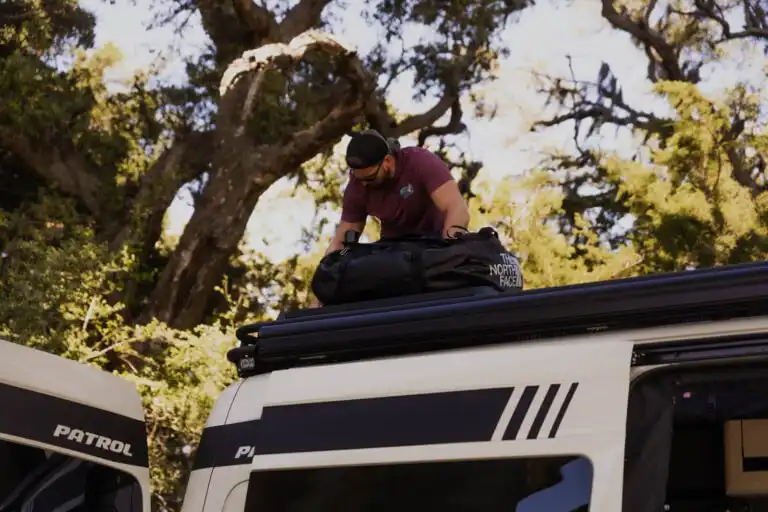
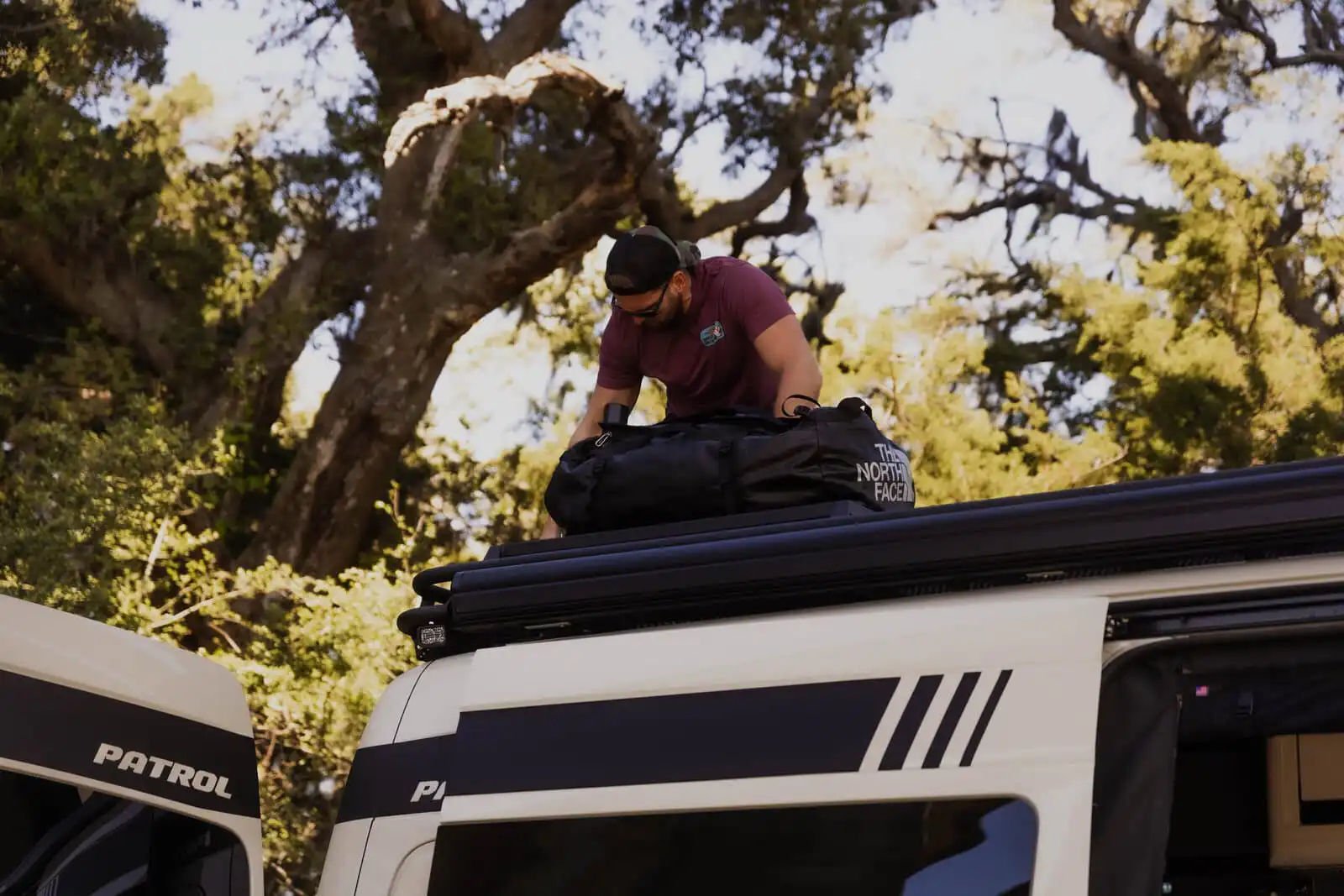
A roof rack on an adventure van generally serves three jobs, and most buyers want some mix of all three. The first is cargo — gear that is bulky, dirty, or occasional. Recovery boards, a spare tire, firewood, a rooftop tent, kayaks, a surfboard. The second is mounting structure for accessories: solar panels, lights, an awning, a shower enclosure, an antenna. The third is a working platform — a deck you can stand on to reach hardware, spot a trail, or set up a camera.
Those jobs pull the design in different directions. A flat, full-length deck is excellent as a platform and for large flat cargo. A modular crossbar system is lighter, cheaper, and better for point-loading specific accessories. A perimeter-rail rack splits the difference and gives you tie-down points everywhere. There is no single correct answer, which is exactly why we spec it per build rather than defaulting to one product line.
The Weight Conversation Nobody Enjoys
Roof load is the constraint that surprises people. A Sprinter’s roof is strong, but “strong” is not the same as “unlimited,” and the number that matters is dynamic load — what the roof can carry while the van is moving, cornering, and hitting washboard — not the static load it can hold sitting still.
Aluminum full-length racks typically run 90 to 150 lb before you put anything on them. Steel racks can be double that. Add a rooftop tent at 130 to 160 lb, two solar panels at 40 lb, an awning at 40 to 90 lb, and a spare tire, and you are carrying several hundred pounds roughly six and a half feet above the pavement on a vehicle that already has a high center of gravity.
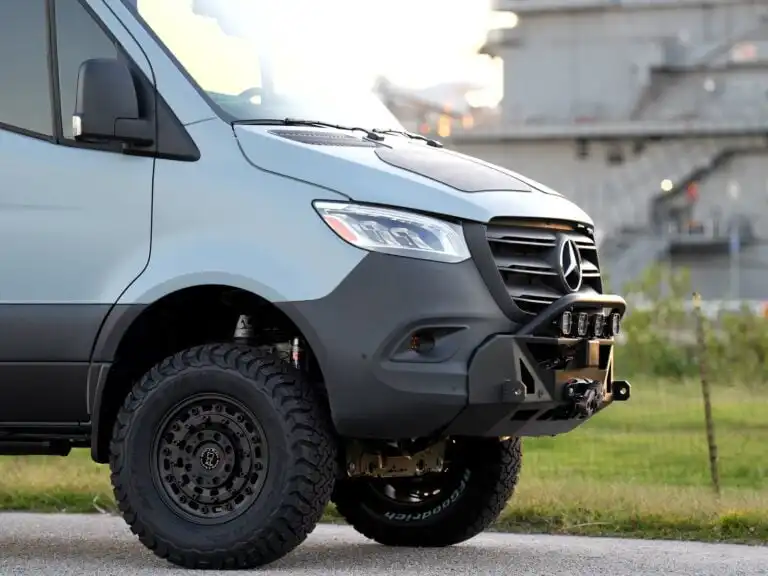
That weight does three things. It raises your rollover threshold in a way you will feel on off-camber trail. It eats into a payload budget that a finished conversion has already spent most of. And it changes how the suspension behaves under load, which is a large part of why we treat roof hardware and suspension upgrades as one decision rather than two.
The practical rule we work to: put heavy, dense items low and inside. The roof is for bulky-but-light, dirty, and occasional. A 45 lb bag of gear on the roof is fine. Your water tank is not.
Rack Construction: Aluminum, Steel, and What Actually Fails
Extruded aluminum is the default for good reason. It is roughly a third the weight of steel for comparable stiffness in a well-designed section, it does not rust, and it accepts T-slot accessory mounting without drilling. The tradeoff is that aluminum is less forgiving of point impacts and more expensive to repair in the field.
Steel racks — powder-coated, usually — are stronger per dollar and shrug off abuse. On a genuinely hard-use utility build, steel makes sense. On a travel van that will spend most of its life on pavement, the weight penalty is difficult to justify.
The failures we see are almost never the rack material. They are the mounting interface and the fasteners. Racks that mount to the factory roof rails or to the Sprinter’s existing threaded roof inserts distribute load into structure that was designed for it. Racks that require drilling new holes are only as good as the backing plates, the sealant, and the person who installed them. A poorly sealed roof penetration will not fail dramatically — it will weep for a year and rot the headliner substrate quietly while you wonder where the smell is coming from.
If you take one thing from this section: ask how the rack attaches before you ask what it weighs.
Wind Noise and Fuel Economy
Every crossbar is a small air brake. On a Sprinter, which is already a large flat-fronted box, adding a full-length rack typically costs one to two miles per gallon depending on speed and what is loaded on it. Fairings help meaningfully with noise and marginally with drag. Slotted or aerodynamic crossbars help with both.
The noise question matters more than most buyers expect. A rack that resonates at 68 mph is a rack you will resent on every long drive. Aerodynamic bar profiles, a front fairing, and — this one is easy to forget — filling unused T-slots with the supplied rubber infill strips make a real difference. Open T-slot channels running the length of the van are a remarkably effective whistle.
Awnings: The Highest Comfort-per-Pound Item on the Van
An awning is close to the best return on weight and money in the entire accessory catalog. Forty to ninety pounds of hardware turns the side of the van into shade, rain cover, and a defined outdoor room. On a Lowcountry summer afternoon, or anywhere the sun is the limiting factor on whether you want to be outside, it changes how the van gets used.
There are three practical categories.
Cassette or box awnings are the rigid-case units that pull out on telescoping arms. They are the most weather-resistant, the fastest to deploy — usually under a minute, one person — and the most expensive. The rigid case protects the fabric from UV and road grime, which matters a great deal for lifespan. They are also the heaviest and add the most width to the van.
Bag awnings are the traditional roll-out design in a fabric or vinyl sleeve. They are lighter and cheaper, cover a similar footprint, and are entirely adequate. The drawbacks are slower setup, more exposure to UV and grit over time, and a bag that eventually looks its age.
270-degree and 180-degree wraparound awnings use articulating arms to cover the side and the rear of the van. For anyone who cooks or works out of the back doors, the coverage is genuinely useful. They are heavy, they need free-standing legs in wind, and they mount far enough outboard that the roof rack has to be specified to take the cantilevered load.
The Mounting Detail That Determines Whether You Like Your Awning
Awnings are almost always mounted to the rack rather than directly to the van body, and the reason is load path. An awning arm extended eight feet with a gust under it generates leverage the roof skin is not designed to absorb. Mounting it to a rack that ties into structural points spreads that load properly.
Mounting height matters more than the spec sheet suggests. Too high and rain sheets off onto your head at the far edge; too low and you cannot stand under the outer arm. On a high-roof Sprinter we generally aim for the leading edge to land around seven feet at the van and pitch slightly down and outward so water runs away from the door.
And a practical note from experience: an awning is not a structure. Sudden Lowcountry thunderstorms and afternoon sea breeze both arrive faster than you can retract one you have staked and guyed. Retract it when you leave camp. Fabric is cheap; an arm bent backward over the roofline is not.
How This Fits an Owl Vans-Equipped Build
Roof hardware works best when it is planned alongside the rest of the exterior system rather than bolted on afterward. On builds where we are already fitting Owl Vans Sprinter upgrades, the roof and the rear doors get specified together, because the same weight budget covers both and because ladder placement links them physically.
The rear door hardware — tire carriers, B2 racks, and ladders — determines where roof access lives. A ladder on the rear door means the roof deck should extend to the back edge with a proper transition. Getting that sequence backward and adding the rack first frequently means cutting or re-drilling later.
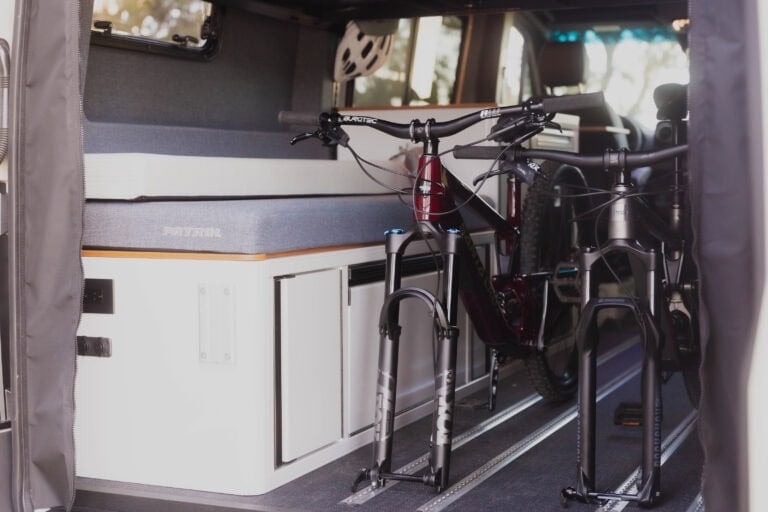
The same logic applies to what goes under the rack. Solar panel placement has to clear the awning’s stowed position, roof vents need clearance for the lid to open fully, and if the build includes a gear garage, the roof and the garage should be dividing the load intelligently rather than competing for the same items. You can see how these systems come together across a whole vehicle in our overland Sprinter build showcase.
For an authoritative reference on factory roof load ratings and mounting-point specifications, Mercedes-Benz Vans publishes the upfitter documentation these builds work from.
Specifying a Roof That Still Works in Year Five
The roofs that age well share a few traits. They carry less than their owners originally planned. They use T-slot mounting so accessories can move without new holes. They keep the heavy items — water, batteries, tools — down low where they belong. And they were installed with the awning, solar, vents, and ladder laid out on paper before anything was drilled.
The roofs that age badly are usually over-specified. A full steel deck bought for a rooftop tent that got used twice, carrying a spare that would have fit better on the rear door, above a suspension that was never upgraded to match. Every one of those decisions is reversible individually and expensive collectively.
If you are configuring a build now, the useful exercise is to list what genuinely goes on the roof, weigh it honestly, and then spec the rack for that list plus a modest margin — not for the version of the trip you might take someday.
Frequently Asked Questions
How much weight can a Sprinter roof rack hold?
The limit is the van’s dynamic roof load rating, not the rack’s own rating, and it is meaningfully lower than the static figure. Most Sprinter conversions should plan on a working dynamic budget in the range of 250 to 330 lb including the rack itself, with the exact figure depending on model year, wheelbase, and roof height. Because the rack can weigh 90 to 150 lb before anything is loaded, the usable cargo allowance is often smaller than people expect. Confirm the specific rating for your chassis before finalizing a spec.
Will a roof rack hurt fuel economy on a Sprinter van?
Yes, though the effect is modest. A full-length rack typically costs one to two miles per gallon at highway speed, more when loaded with bulky items. Aerodynamic crossbar profiles and a front fairing reduce both drag and wind noise. The larger practical penalty is usually noise rather than fuel.
Can you mount a roof rack without drilling into the roof?
Often, yes. Sprinters have factory threaded roof inserts and, on some configurations, factory rails that a properly matched rack can use without new penetrations. This is the preferred approach because it puts load into structure designed to take it and eliminates the leak risk that comes with new holes. Racks requiring drilling can be entirely sound, but the quality of the backing plates and sealing becomes the deciding factor.
Should the awning go on the driver or passenger side?
Passenger side, in nearly every case for a US-market van. That puts the shaded area on the same side as the sliding door and away from traffic when you are parked roadside. The exception is a build where the primary outdoor working space is at the rear doors, where a 270-degree awning mounted on the driver side sometimes gives better wraparound coverage.
How long does an awning last?
Fabric life is driven almost entirely by UV exposure and how wet it gets stored. A cassette awning that lives in its rigid case will commonly go eight to ten years before the fabric needs replacing. A bag awning in a sunny climate may need attention at five. Rolling one up wet is the single fastest way to shorten its life — mildew degrades coated fabric quickly.
Can I add a roof rack to a van that is already built?
Usually. Roof racks are one of the more retrofit-friendly upgrades, particularly if the build used factory mounting points and left conduit runs accessible. The complications come from existing roof penetrations — vents, solar, antennas — that constrain where bars can land, and from payload that has already been spent elsewhere. It is worth a weight audit before committing.
Getting the Roof Right
A roof rack and an awning are not accessories in the ordinary sense. They change the van’s payload, its handling, its noise floor, and how much of your time gets spent outside it. Specified deliberately — matched to a real cargo list, mounted into real structure, and balanced against the suspension carrying it — they are among the highest-value additions to an adventure build. Specified reflexively, they are several hundred pounds of expensive regret riding six feet off the ground.
If you are planning a build and working through how the exterior systems should fit together, talk with the Patrol Vans team about your actual load list. It is a much shorter conversation than reworking a roof later. You can also compare the OmegaVan configuration to see how utility-focused roof and rear-door hardware works on a build designed around carrying capacity from the start.